Here’s a number that should make you uncomfortable: $31 billion.
That’s what the U.S. construction industry loses to rework every year. And if you think that’s somebody else’s problem, pull up your last three projects and look at the change orders, the RFIs, and the schedule slippage. Somewhere in there, you’ll find rework. You always do.
But here’s what most owners get wrong: they think rework is a field problem. It’s not. Rework is an upstream problem that shows up downstream. The mistake was made in pre-con. It just didn’t announce itself until your crew was on site.
I sat down with Scott Reynolds, co-founder and CEO of UpCodes, to dig into exactly where these mistakes originate and what you can do about them. Scott comes from an architecture background — he studied at Syracuse — and he’s spent nearly a decade building a platform that aggregates building codes, fire codes, and electrical codes into one searchable, AI-powered database. His perspective on where rework starts is worth your attention.
The 1-10-100 Rule
Scott laid out a framework that every construction leader should tattoo on their forearm. He calls it the 1-10-100 rule.
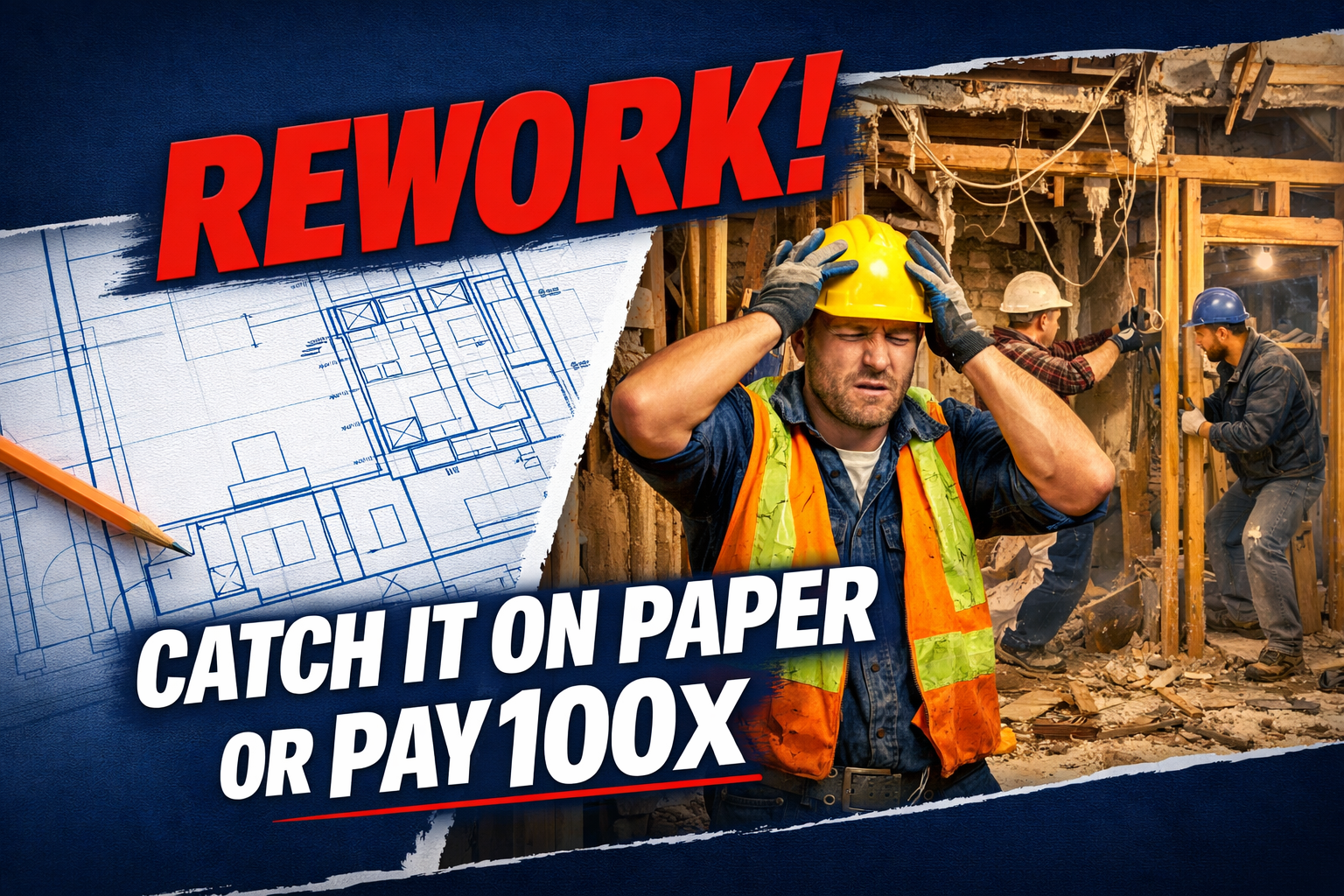
Catch a mistake on paper during pre-con? That’s a dollar. Catch it after it’s built and you’re doing rework? That’s ten dollars. Let it slide past inspection and into occupancy? A hundred dollars.
Now multiply that ratio by whatever your last change order looked like. Suddenly we’re not talking about dollars. We’re talking about tens of thousands.
The math is brutal and it’s simple: every phase transition multiplies the cost of a mistake by 10x. That’s why the most profitable construction companies obsess over pre-con. Not because it’s glamorous. Because it’s where the money is saved.
The Handoff Problem Nobody Wants to Talk About
So where do these mistakes actually come from?
Scott pointed to the handoff between design and construction. The architect writes the specs. They work with the government to get things permitted. Then that package gets lobbed over the fence to the GC or the trades.
And right there — in that handoff — is where the wheels start coming off.
The architectural plan set doesn’t match the structural. The specifications don’t match the drawings. The GC’s pre-con team is trying to reconcile documents that were never fully coordinated in the first place. It’s not that anyone is incompetent. It’s that the process itself creates gaps.
Think about how many times you’ve seen this: the architect is done, they hand it off, and the GC finds 200 RFIs. Nobody wanted that. Nobody planned for it. But the current workflow makes it almost inevitable.
The Gray Area Problem
Building codes aren’t perfect. They’re written at the lowest common denominator so they apply to every project. But every project is unique. So how does your unique project apply to the code?
That’s where things get murky.
As Scott put it, the building departments and fire departments have the authority to interpret the code in different ways. And they will. Across the country, at the state level, the city level — even between individual inspectors in the same department — you can get dramatically different interpretations of the same code section.
This is why your relationship with the local building department matters so much. If you’ve worked in a jurisdiction for years, you understand how they typically interpret things. You’ve got historical projects to reference. That portfolio depth gives you leverage in conversations that a first-time contractor in that jurisdiction simply doesn’t have.
Where AI Actually Helps (and Where It Doesn’t)
Everybody’s talking about AI in construction right now. Most of it is hype. Here’s where it’s actually working.
Scott’s team at UpCodes has aggregated over 6 million sections of building code into one searchable database. Twelve thousand of those sections are updated every month. It’s a massive, constantly changing body of information that no human can keep up with manually.
AI lets them parse all of that in real time. A pre-con manager can ask a code question and get a cited, verified answer in seconds. A roofer on site can pull up their phone and ask about a nailing pattern instead of hauling code books in a wheelbarrow.
But here’s the critical part: the AI isn’t making decisions for you. When there’s a gray area in the code, the system flags it and tells you a decision needs to be made. It equips you with the right information. The judgment call is still yours.
That distinction matters. AI that makes confident but wrong calls is worse than useless in construction. The guardrails UpCodes builds — tying every AI answer back to the actual code with citations — are what make the tool trustworthy. Without those guardrails, you’re just getting a confident hallucination.
Both Sides of the Table Need the Same Facts
One thing Scott said that stuck with me: so much rework happens because two parties are having two different conversations. They’re not arguing because they disagree. They’re arguing because they’re working from different information.
The architect has one set of facts. The GC has another. The inspector has a third. Nobody’s wrong. They just don’t have the same foundation.
If you can get everyone operating from the same set of facts — the same code interpretation, the same specifications, the same plan set — the conversations become productive instead of adversarial. That’s not a technology problem. It’s an information transparency problem. And it’s solvable.
Where to Start
If you’re a construction company owner looking to reduce rework and delays, Scott’s advice is straightforward: put your energy upstream.
Invest in pre-construction. Catch coordination errors, compliance gaps, and specification mismatches while they’re still on paper. Have the uncomfortable conversations with your architect and your design team before your crew is on site. Equip your pre-con team with tools that surface problems on day one, not day ninety.
Remember the 1-10-100 rule. Every dollar you spend catching mistakes on paper saves you ten on the jobsite and a hundred after handover.
The cheapest rework is the rework that never happens.
Listen to the full conversation with Scott Reynolds on the Construction Genius podcast. Links to UpCodes and Scott’s LinkedIn are in the show notes.