From civil engineering to superintendent: leading a jobsite without trade experience
This article is a lightly edited transcript of my conversation with Erin Saiki on the Construction Genius podcast. I cleaned it up for reading, but the words are hers. To hear the whole thing, listen to Episode 365.
Erin Saiki runs work for DPR Construction in the Bay Area, and she got there without ever working a trade. She studied civil engineering at UC Berkeley, interned with DPR in 2018, and took the field-first path from project engineer to field engineer to superintendent. Three to four years into the role, she stands in rooms full of foremen who have decades of craft experience she doesn’t have, and she leads them. This post is about how she pulls that off, and what it teaches the rest of us about leading a jobsite when you didn’t come up through the trades.
Why an engineering grad chose the field over the office
Eric: Walk us through your path. You started in civil engineering at UC Berkeley and you’re now a superintendent at DPR.
Erin: I started out thinking I’d go into structural engineering. I did an internship with DPR in 2018, fell in love with construction, and realized I no longer wanted the structural route. I hired on full time as a project engineer, which is the primary path out of college for most construction companies. Within the first four or five months, I felt like I was being pulled into the field. My skills were better suited for it, and I was more excited to be on site than in an office. DPR has a program that lets you switch to a field engineer route, the mirror image of the PE path. A PE goes toward project management. A field engineer goes toward superintendent. That started me on the path.
Eric: What were you finding in those first few months that changed your mind?
Erin: Seeing the actual work get installed. We teach project engineers a lot of it by looking at drawings, but where it clicked for me was watching it get built. The way I learn, being able to touch things and see them, that’s what made it click. It pulled me toward the field, talking with the craft, understanding how everything goes together.
An internship is where you show someone your company and get to know them. Both of you find out whether the work even fits. Don’t spend it forcing an intern into your box. The real question is whether your box is right for them. And if you’ve got more than one box, which one? Erin walked in headed for structural engineering. DPR didn’t cram her into the mold. They showed her the field, she found her fit, and they kept her.
Curiosity, not craft experience, is a new superintendent’s best tool
Eric: What was it like stepping onto job sites with no trade background, in those first couple of days?
Erin: Nerve-racking. A little nerve-racking. But the most powerful tool someone has in the field is curiosity. I went in asking a lot of questions and finding that you don’t need to know everything. No one knows everything. I know many awesome superintendents who don’t. People take a lot of pride in what they do, and they’re excited to explain it to you. Once I got comfortable knowing I don’t need all the answers, I just need a good attitude and the right questions, the rest came.
Your new hires are babes in the woods. They’re clueless and probably scared. So tell them straight: it’s okay to ask questions, and you’re not here to be an errand boy or an errand girl. Sure, they pay their dues and do the job. But you always want a new person to get a glimpse of the big picture and a feel for what building is all about. Erin’s tool was curiosity. Somebody had to tell her it was safe to use it.
Finding your voice as a superintendent means knowing your next move
Eric: What was your first day as a superintendent like, stepping into a leadership role?
Erin: It was an experience of finding my voice. By asking all those questions, I’d built the knowledge I needed. What it came down to after that was standing in a room full of foremen and confidently walking through what we need to be doing on site. I create a culture where we’re all in it together, because that’s the only way I can succeed. My background doesn’t let me walk in and say, “This is how we’re going to do it.” I’d get gut-checked by anyone who actually builds.
Eric: That concept of finding your voice. What do you mean by it?
Erin: Knowing your tools and your style, so that when you’re faced with a question, you don’t freeze. Even if I don’t know the answer, it’s being collected enough to say, “Let’s go talk to the structural engineer,” or “Let’s go look at this in the model,” or “Let’s go take a field walk.” Having that reaction takes time to build. Those first days, I’d look at my senior superintendent to check I was aligned. Now I can run any scheduling meeting without that backup.
Collaborative leadership still ends in a decision
Eric: How do you balance the collaborative style with the fact that you’re the superintendent and the call is yours?
Erin: We don’t want analysis paralysis. Everyone wants what’s best for them, but not everyone can get 100 percent, so we all make compromises. It helps that I don’t have building experience, because I don’t have a bias toward any one trade. If I’d come from a plumbing contractor, I might lean toward the plumbers. Because I don’t, I can step back and say, “I hear you. This isn’t 100 percent of what you want, but it’s what the job needs.” When you explain the why, people are usually understanding. At the end of the day the superintendent has to make the call. But I make a better call when I’ve heard all the voices, because at that point I take myself out of it and ask, “What’s best for the job?”
Eric: Why do you think being questioned by foremen is something you welcome?
Erin: Being questioned isn’t a bad thing. If you can answer the question, you know you’re solid. If you can’t, that puts your defenses up, and it means you missed something. So what did I miss, and what can we do about it? I have foremen who tell me they bring things to me they can’t bring to other supers. That’s rewarding to hear, but it’s also eye-opening, because without that style it would have stayed silent.
Psychological safety is a production tool, not a soft skill
Eric: What do you mean by psychological safety on a job site?
Erin: We talk a lot about safety: falls, cranes, electrocution. Psychological safety is about how mentally everyone feels at work, because that comes through in the work they do. If you’re not in a safe space to speak up, you won’t report the things that are hazardous. You might think, “If I report this, I’ll be let go, or shamed.” That downstream affects physical safety too. It’s building a culture where the craft can bring up a concern and you actually listen and follow through. It’s not accepting things as “that’s how we’ve done it for 50 years.” At DPR we’re working to make sure every site has plumbed restrooms with running water, where portable toilets have been the standard for years.
Eric: How do you balance psychological safety with performance?
Erin: They go hand in hand. When people bring things up, they perform better. It’s as simple as someone saying, “This job isn’t clean, it’s unsafe to have all this debris around.” That change makes the job more productive. People will tell you what they need. You just have to be willing to hear it and do something about it. When a job is psychologically safe, morale is good, and people take pride in their work.
How to sell construction technology to skeptical craft workers
Eric: You use robotics, BIM, and VDC on job sites. How do you bridge the gap with craft workers who are skeptical?
Erin: The skepticism is fair. They don’t want to be replaced, and they’re worried about their livelihood. The first way we address it is training and awareness, not the broad idea that robots take your job, but what these robots actually do. Right now everything we use needs a person to run it. Our layout robots are operated by carpenters, so the carpenters are still doing the layout, just in tandem with a robot. A lot of these robotics increase production. If we’re more productive, we’re cheaper, which means we win more jobs, which means we can put you to work. It comes full circle. I like the term cobotics. It’s a robot working in tandem with you, to augment you in the field. And a lot of the innovations are safety-related. We’re piloting robots that flip breaker switches when we’re energizing, so a worker isn’t touching a breaker that could arc flash and seriously injure them.
Eric: So you’re giving the foremen the business case. Is that consistent, or a one-time thing?
Erin: Consistent. As we pilot new technologies, we’re always having those conversations. We put these tools in the hands of the craft and ask for feedback, so it becomes a tool they want to use. If you don’t have that transparency, they’re in the dark, and I get why they’re skeptical. They think you’re coming after their job. Really we need to get faster and cheaper because that’s what owners expect, and that’s how we keep winning work so they can keep working.
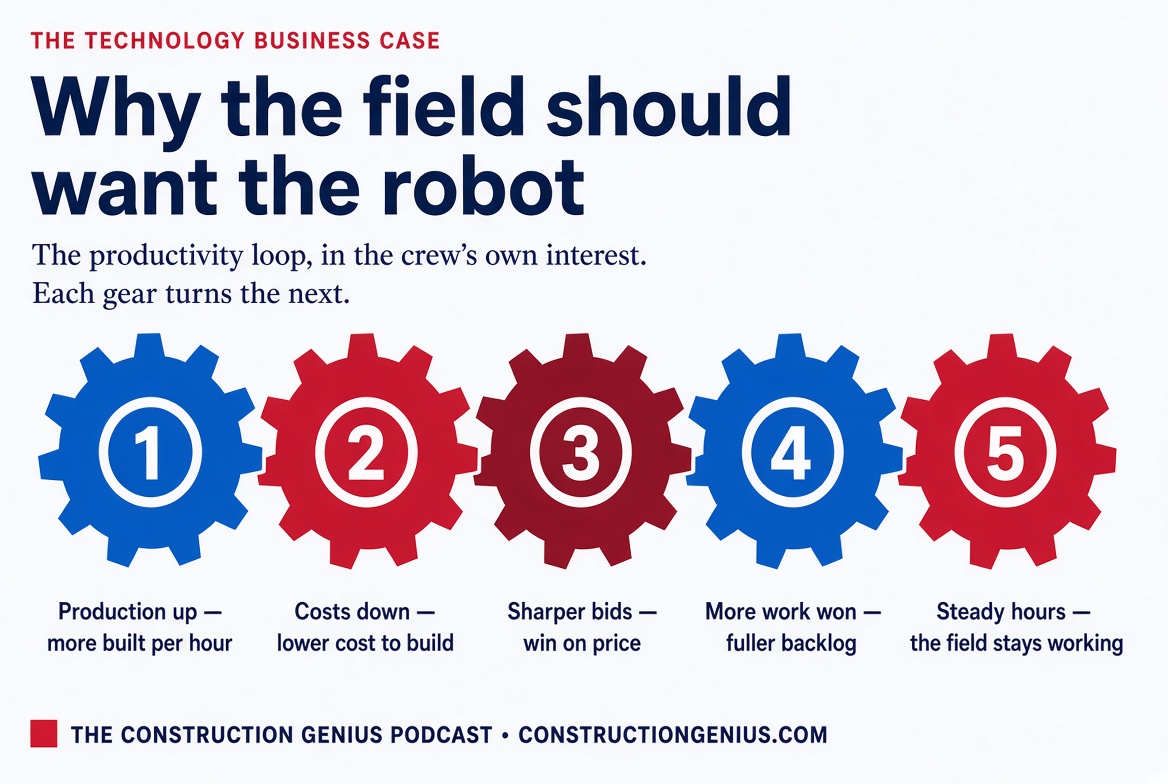
If you want the field to buy in to new technology, give them a good reason. It’s straightforward, and it’s the case you have to make every time you put a new technology on the site. The technology is here to make you better and faster, and to help us build cheaper. Nobody’s job is on the chopping block. The carpenter still runs the layout robot. The robot just makes him faster. Build cheaper, faster, and better, and the client is happy, which wins us more work with them. We can also bid the next job at a lower number, and that wins work too. Happy clients and more projects add up to a full backlog, and a full backlog means steady hours for the field. No sitting home waiting for the next job.
Filter every jobsite technology through better, faster, cheaper, safer
Eric: : How do you stay on the cutting edge without chasing technology for its own sake?
ErinWe need to be responsible about supporting good technology. As a tech-forward super, I want to use technology, because my skill lends to it. But we can’t be so biased that we let things go to the field that aren’t good. The reality check comes from the superintendent and the field, not the office side. I check myself too. “Am I saying this is good because it’s a cool new idea, or is it actually good?” There are ways we’ve done things for 50 years that are still the most efficient and accurate. New doesn’t automatically mean better.
Run every new tool through one test. Does it help us build better, faster, cheaper, or safer? Count the yeses. If you can’t get to two, don’t bother. The hassle of getting a new tool onto the site isn’t worth it for a maybe. And if the honest answer is “it looks cool,” walk away. Erin’s as tech-forward as they come, and even she checks her own bias, because a tool that dazzles in the trailer can die in the field. The people who get the final say on jobsite technology should be the ones holding it.
Put the superintendent in the design phase
Eric: How does getting involved early in design change your effectiveness?
Erin: I’m a huge advocate for it. I’m always disappointed when I come in mid-phase and there wasn’t a superintendent in the design phase, because on day one I can see the RFIs a constructability mind would have prevented. I can be ten times more impactful in the design phase than in the build phase, because I can prevent issues before we get there. Flying around the model, I can say, “I won’t be able to get a scissor lift in there safely. Can we flip this around?” By the time it hits the field, no one hears about it, because it was already fixed. We also learn the design intent early. Later, when people want to do things different ways, I can say, “This has to go here because the owner expects their doctors to use this space this way.”
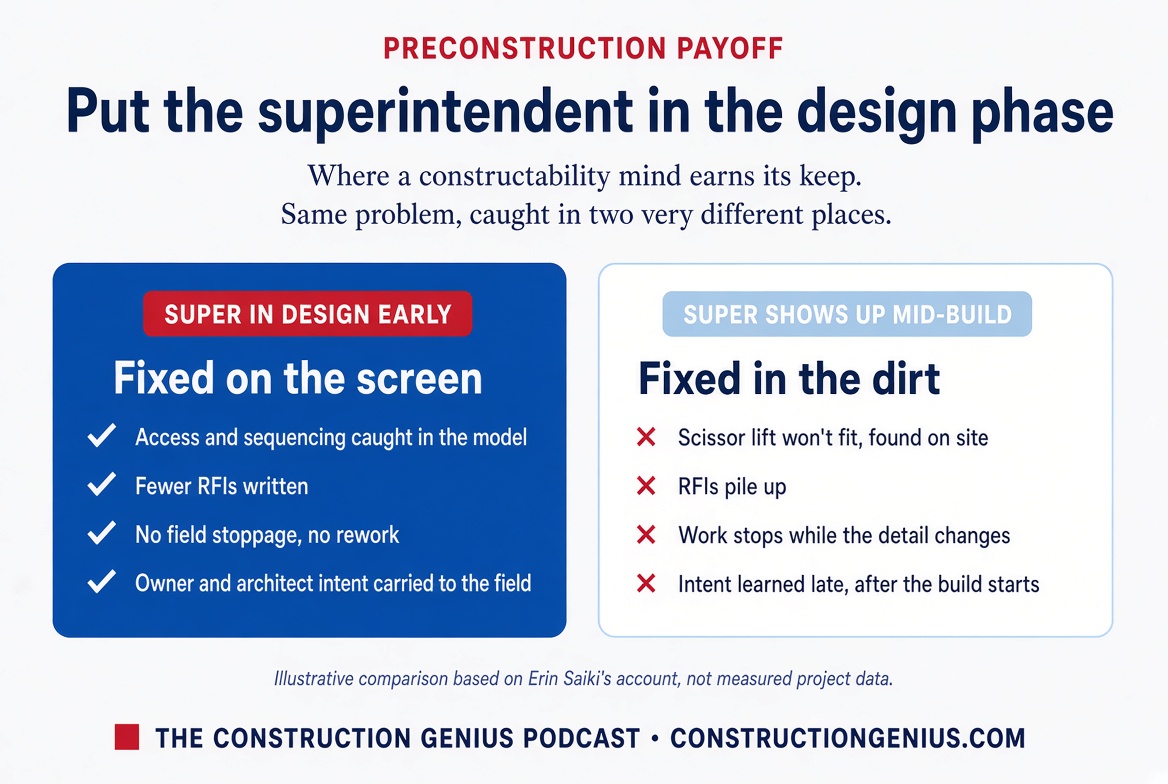
Get your superintendent involved in the design phase. Yes, that pulls them out of the field for a while. But their time up front, their eyes on the plans, and their feedback before you stick a shovel in the ground save you far more hassle and cash once the job kicks off. Erin spots the scissor lift that won’t fit and the detail that can’t be built while it’s still a line on the screen. Nobody in the field ever hears about it. You fix it in the model for the cost of a markup, or you fix it in the dirt for the cost of a stoppage.
Construction’s biggest safety gap is mental health
Eric: One of the major concerns in the industry is mental health. How are you and DPR addressing it?
Erin: The resistance comes from shame and stigma. Everyone likes to think they’re strong and don’t need help. Construction is full of proud people, and that pride is a strength, but here it causes resistance. We take active steps: talking about it openly, sharing stories, having trades foremen come up at all-hands safety meetings and share stories about people they’ve known who took their lives. I’m a numbers person, and this was eye-opening. Construction has one of the highest suicide rates of any industry. We spend all this time on physical safety, all these OSHA rules and permits, and this is bigger.
Eric: Why do you think that is?
Erin: It’s a high-pressure industry. We’re always going fast, with a lot of overtime and a lot of dates to hit, and that takes people away from sleep, rest, and family. It’s physically demanding, and some people try to mitigate that with substances to show up every day, which can play a role in overdosing. Combine that with a bad environment where you feel treated like trash, and that’s a concoction for something not good. It goes back to morale and culture, knowing you’re coming to a community that treats you like a human.
Construction has one of the highest suicide rates of any industry. The figure the industry cites most is about four times the national average (53.2 versus 17.3 per 100,000), and roughly five times the number of workers lost to all other on-the-job construction fatalities combined. We regulate the falls and the electrocutions down to the permit. The bigger killer gets a fraction of the attention.
If you or someone on your crew is struggling, the 988 Suicide and Crisis Lifeline is available 24/7 by call or text. The Construction Industry Alliance for Suicide Prevention (preventconstructionsuicide.com) keeps jobsite resources for crews and leaders.
The superintendent owns the schedule, so the superintendent owns the stress
Eric: What hard conversations are superintendents not having that they should be?
Erin: Two things. First, staying in tune with the craft. The more you get into meetings and owner relationships, the harder that gets. I remind myself my job is to serve the field, and to balance correcting people with caring about them and recognizing good work. Second, the superintendent drives the schedule, and therefore the stress and pressure of the job. When the field is crunched and we’re not appreciating the work, morale and safety drop. Some overtime is real, but months of it means we planned something wrong. And you have to be willing to have the unwelcome conversation, because the alternative is a fatality from stacking crews.
It’s easy to walk a job and only see what’s broken. Patch that, barricade this, redo the corner. All of it’s real and all of it has to get said. But a super who only corrects teaches his crew to brace when he shows up. So recognize the good work, especially when it goes above and beyond. Make it personal, specific, and consistent. Tell a guy his finish looks clean, and say it the same day. Ask about his family while you’re at it. Don’t wait for the barbecue at the end of the job, after you’ve run people through a year of hell. That’s too late. What matters is what you say on the walk this morning.
Judge the day by whether you had the hard conversation
Eric: How do you manage yourself going into those conversations? For a collaborative person, confronting someone can be intimidating.
Erin: I’ve been through a lot of coaching. A lot of the time it’s telling myself I can only control what I can control. In my head I’ll decide, “This is the response I’ll get, so it’s not even worth having the conversation.” It comes back to the only thing I can do is give the feedback. How it’s received will never be something I can dictate. Sometimes it doesn’t go well, and that’s okay. At least I can go home and sleep knowing I tried. Over the past two years I’ve gotten better at facing them head on instead of circling the bush for two weeks. Then people ask, “Why didn’t you tell me two weeks ago?” Because I was working up the courage.
You control one thing here, whether you have the conversation. How the other person takes it was never yours to decide. So have it, and learn to have it early in your career. The longer an issue drags on, the more pain it causes and the more money and credibility you lose. A leader who ducks the hard conversation stops being able to lead. Erin sat on hers for two weeks, working up her courage, until people asked why she waited. Don’t let that time pass. The measure of your day is whether you went home having said the thing you needed to say. Say it today, and sleep tonight.
Staying adaptable is the whole job
Eric: How do you see the superintendent’s role evolving over the next five to ten years?
ErinThe role, the responsibility, and the accountability stay the same. The tools change. What a superintendent needed five or ten years ago is different from now, and it’ll change again. It pains me to say this, because I told myself I’d never become this type of superintendent, but the key is staying adaptable and not getting complacent. Even as a tech-forward super, I’m starting to feel it. College students are coming out wielding AI, and that’s something I’m less fluent in. In ten years that might be the average, and being a tech-savvy super won’t be a differentiator anymore. So I remind myself to keep learning.
Advice for breaking in without trade experience
Eric: For college students and early-career folks who lack trade experience, what’s your advice for building credibility?
Erin: Be the first to volunteer to be in the trenches. Show up. If there’s a 4 a.m. concrete pour, you’re there. People will teach you if they see you want to work. And find what makes you useful. For me it was the technology. You need to find the thing that makes you useful and that people come to you for. From there the relationships build.
What she’d tell her younger self
Eric: If you had to start your career over, knowing what you know now, what’s one thing you’d do differently?
Erin: It hasn’t been linear, and the dips and turns are what make me who I am. The time I spent as a PE was important, because now it makes me more effective working with PEs. And a lot of the mistakes I’ve made, which most people would want to erase, are the defining features of me learning to be a better superintendent. I can’t think of something I’d change, because those things shaped me into the superintendent I am.
If you’re mentoring somebody coming up, tell them the path runs crooked. There are dips and there are turns. The dips are the mistakes, and they’re useful as long as you learn from them. Don’t let them get too deep or too wide before you climb out. You do that by catching the mistake as fast as you can, owning your part in it without excuses or blame shifting, and doing everything you can not to repeat it. The turns are where you learn. New project, new crew, a new leadership style to read every time. That’s how you learn to build, and how a builder turns into a leader.
Key takeaways
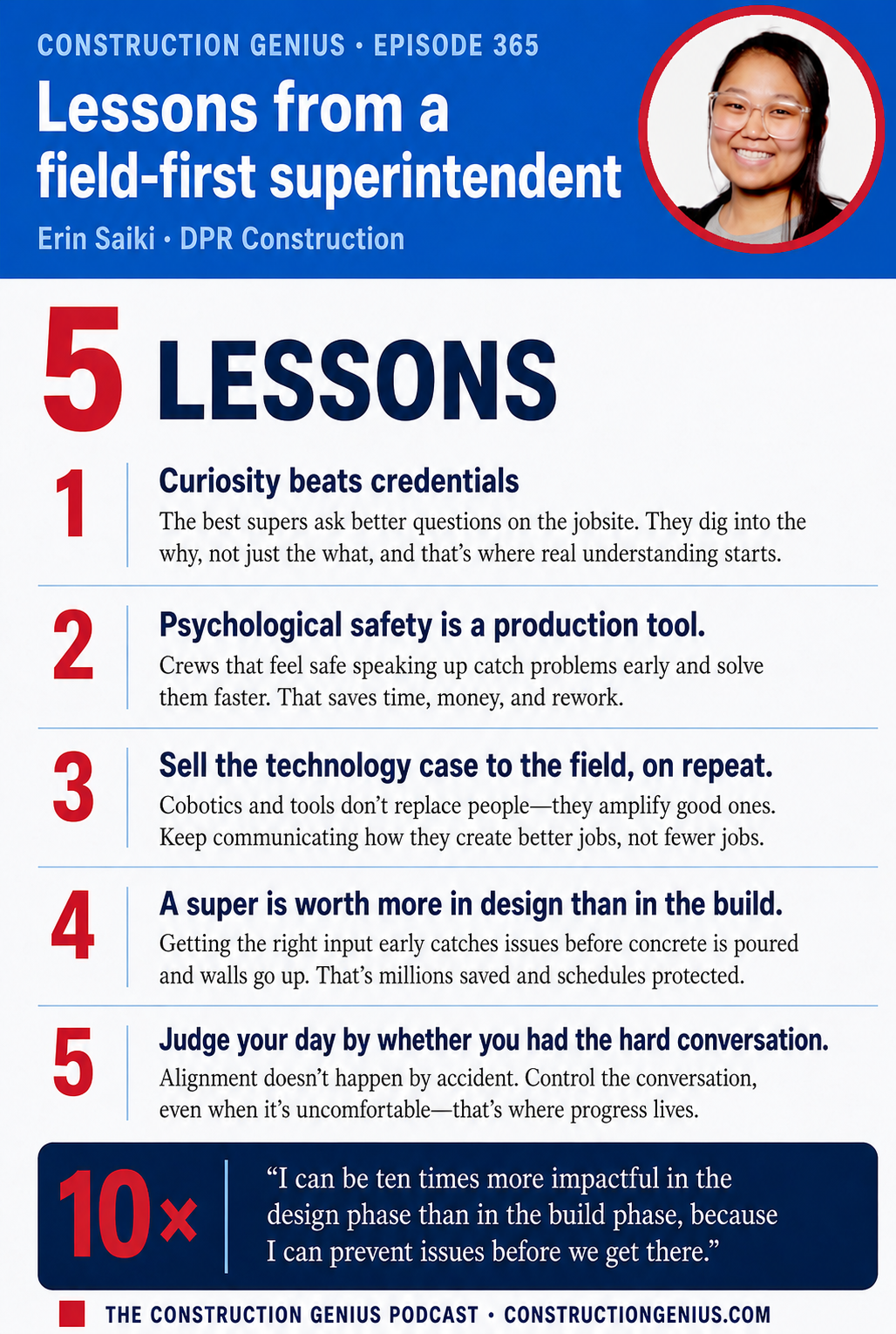
- Curiosity beats credentials. With no trade background, the strongest tool on a jobsite is asking questions and chasing the answers down. Nobody knows everything, including veteran supers.
- Psychological safety is a production tool. A crew that feels safe to speak up surfaces the constraints and hazards a silent crew eats. Safety, productivity, and morale move together.
- Sell the technology business case to the field, on repeat. The pitch that lands isn’t the gadget, it’s the loop: faster and cheaper wins more work, and more work keeps people employed. Cobotics augments the worker, it doesn’t replace them.
- A superintendent is worth more in design than in the build. Catching the scissor lift that won’t fit while it’s still a line on the screen prevents the RFI and the field stoppage before they exist.
- Judge your day by whether you had the hard conversation. You control whether you have it, never how it lands. The longer an issue drags, the more pain, money, and credibility you lose.
🎧 Hear the full conversation on Construction Genius Episode 365
Develop the leaders your company runs on
Most of what Erin describes comes back to leadership. Can your superintendents run a room and have the hard conversation? Can they build a crew that speaks up? That’s what I train construction leaders to do. Through my coaching and leadership programs, I help owners and their teams make the shift from building projects to building people. If that’s what your company needs, book a 10-minute call and we’ll figure out whether it’s a fit.