Mark Whitson started at DPR Construction with his tools in his hands and leads the company as president today. That path tells you most of what you need to know about how DPR builds people. I sat down with Mark on the Construction Genius podcast to work through how a construction company keeps its best people for decades, hands its culture from one generation to the next, and grows without losing what made it work in the first place.
What follows is our full conversation, lightly edited so you can read it fast. If you lead a construction company, or you want to, there’s a lot to learn from.
From Carpenter to President: The Turning Points in a Construction Career
Eric: You started your journey in construction as a carpenter, and now you’re the president of DPR. What were the turning points for you in that journey?
Mark: There are a ton of turning points I think about, and some of them started right out of school. I went to Purdue as a civil engineer with construction. DPR was slow at the time in Arizona, and the opportunity came up to join our self-perform crew. As a college grad, you tend to think you’ve accomplished a lot, and you’ve got some ego. Going to work with my tools was probably the first turning point. I recognized I needed to be willing to do whatever it took, to learn, and to be curious.
I chose DPR for a reason: the culture, the core values, the things it stood for. Taking the leap to say “I’m going to go do something I didn’t expect to do” and knowing it would be a great learning experience — boy, did it transform my career. It gave me an appreciation for what it meant to be a craft employee of any firm. I grew up on my grandparents’ farm, but I never worked with those kinds of tools in that kind of setting. What an appreciation it gave me that I’d never have had otherwise.
How DPR Actually Lives Its Culture Instead of Posting It on a Wall
Eric: DPR is well known as a company driven by culture, and it’s been emphasized since the founders started in the Bay Area. A lot of companies talk about culture and put their values on their website. What is it about DPR that lets the company actually live out that culture in real time?
Mark: It starts with the philosophy Doug, Peter, and Ron founded the company on: don’t take yourself too seriously. Even as the founders, don’t treat yourself as any more important than anybody else. There’s a lot of modesty and humility in that. It shows up in ways you notice — when I interviewed at other places out of school, it was suit and tie. At DPR, there were people in camp shirts with surfboards on the wall. It was more informal, and it let people be more themselves. Just walking in the door, you could feel the difference. That permeates all the pieces of DPR’s culture in a bunch of different ways.
Why Every Role in a Construction Company Matters
Eric: When you started in the self-performing group, did you see yourself as the future president of the company? Or how did that develop?
Mark: I definitely didn’t see myself as president. Did I have aspirations to take on more? Absolutely. But that experience in our self-perform crews made me realize the folks in our office or our trailers are not more than a carpenter or a laborer in the field. They’re just different — different roles, different careers.
Something we have to keep teaching today’s workforce and tomorrow’s is that we need people in all roles, and we need people to be great in all roles. Everybody is in a different place along that journey, meant for a different destination based on their skill sets, talents, and passions. Too often we try to put everybody in the same box. As an industry, there’s a big opportunity there. At DPR we’ve been heavily focused on recognizing that everybody’s running their own race.
The Mentors Who Shaped a Construction Leader
Eric: In construction there are so many roles that there’s an opportunity for everyone to participate. As you were getting going, who were the leaders or mentors who had the biggest impact, and what stuck with you?
Mark: Two buckets come to mind. One is the foremen in our self-perform crew — Jesse Jiménez and Mike Walters, two long-term DPR employees. Mike just retired after 25 years as a carpenter and foreman. They taught me what it was like to bridge the gap between craft and admin, to know how to communicate in both groups and settings.
The second is Mike Ford and Dave Elrod, two of the leaders in our Arizona office. Dave and I joke that he didn’t want to hire me out of college because I was looking for an extra $2,000. He taught me a lot, personally and professionally — how to be a good human, a good teammate, to have the work ethic and the willingness to do whatever it took.
Mike Ford taught me that not all of the best opportunities in your career are right in front of you, and not all of them are the ones you think are right at the time. There may be opportunities outside your current geography or work group. The individual path you’ve painted in your head isn’t the only thing you have to choose from. He was great about two things: always putting opportunities in front of me and involving me in those conversations, instead of my path being handed to me — and being willing to listen when I had an idea about my next step. Both Dave and Mike opened doors for me that I’m fortunate I was willing to walk through.
Bridging the Gap Between Craft and Office in Construction
Eric: On bridging that gap between craft and admin — what did they focus on to teach you how to do it?
Mark: The first was learning Spanish. I had some in high school and college, which helped, but really learning the phrases used most often so you could communicate better. It showed a willingness to meet craft employees who are Spanish-speaking where they are.
The other is recognizing that the folks in the field have a lot to teach the office too. Too often an office employee is intimidated by the craft because they don’t understand the technical work, so they avoid the interaction. And a lot of times the craft employees are intimidated by the office for different reasons. Some of that’s cultural, but some of it is that the industry, over the last 50 years, has generally looked down on craft as not equivalent to an office employee — and that’s embedded in the mindset of craft employees themselves. Treating that in small groups with our crews and foremen, being willing to push back on some of that discomfort, was a pretty interesting dynamic.
Careers in Construction Are a Rock Wall, Not a Ladder
Eric: How did they go about presenting you with these opportunities, and how did you push back with your own perspectives in a way that shaped your career?
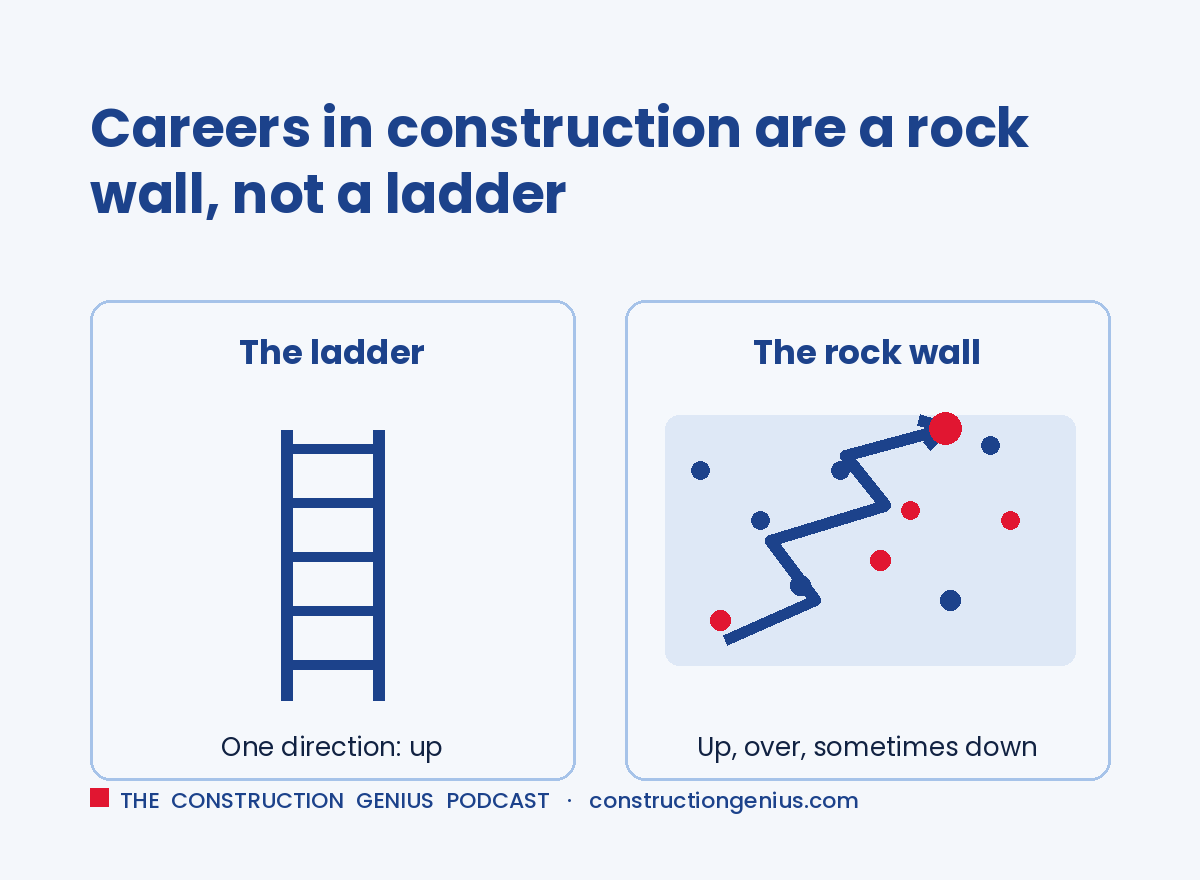
Mark: I’ll start with an analogy we use a lot. A lot of companies think about a career path as climbing a ladder. At DPR, we view it more like a rock wall. You generally know the direction you want to go, but sometimes you go up, sometimes left or right, and sometimes down in order to go left, to go right, to go up.
That mindset put a few principles in place for me. One, there are going to be obstacles, and you have to figure out how to work around them. Two, where you want to go — you may not get there right now, but you may get there later. Three, sometimes it’s easier than you think, and you need to give it a try. All of those have helped me push, pull, and tug through the journey of what’s next.
My take
People quit when they think they’ve run out of room. Usually they haven’t. There’s a lateral move that would restart their growth, and nobody put it in front of them. When a good project manager tells you they feel stuck, show them the next hold before they hand you their notice.
What to Do When a Top Performer Gets Restless
Eric: On LinkedIn it looks like you’ve been with DPR since college — like you just did the ladder, or at least the upward slope. Was there ever a point of despair, where things weren’t working out the way you wanted?
Mark: By no means was it perfect and exciting all the way through. Anybody who says that about their career isn’t being truthful. One point comes to mind: I’d been in Arizona seven or eight years and was one of the younger folks emerging into leadership. We had a six- or eight-person leadership team, and they were generally 10 to 20 years older than me. I was bumping up on tenure, or the perception of tenure. I was frustrated and impatient — a young kid in his 20s who thought he could conquer the world.
But in reality, it was more about my personality. I was getting a little bored. I was looking for a different challenge, and it was less about what role I was in or whether I was on the leadership team. It was more about whether I was doing something exciting that stretched me. Creating those conversations opened doors — eventually to relocating to Utah to help lead a big project. It also helped me learn what was eating at me. It wasn’t the company or the team. I was looking for something to keep challenging me.
Boredom or a Bad Attitude? Reading Your People Correctly
Eric: From another person’s perspective, you might perceive someone as having a bad attitude or underperforming, when it’s simply boredom and they need a new challenge.
Mark: We underestimate — and it’s a muscle we’re still strengthening at DPR — just having more one-on-one conversations, and not assuming whether it’s a performance issue or an unhappiness issue. There are a ton of things a person’s mentality can be based on: mental health, boredom, frustration, a bad manager. Realize there’s more than one answer, and don’t assume you know what it is.
My take
Before you write someone off as checked out, ask whether they’re bored. Your best field engineer going quiet in month eighteen usually isn’t a discipline problem. He’s run the same kind of job three times and stopped learning. Ten minutes on what he wants next will tell you more than another performance review. I’ve seen firms lose a future superintendent over a problem a new assignment would have fixed.
How Retaining Top Talent Drives Company Growth
Eric: One of the biggest challenges construction companies have is retaining talented people, because they only have so many seats. You mentioned bumping up on tenure. What impact has DPR’s ability to keep top people had on the strategic direction of the company — opening up new geographies or markets?
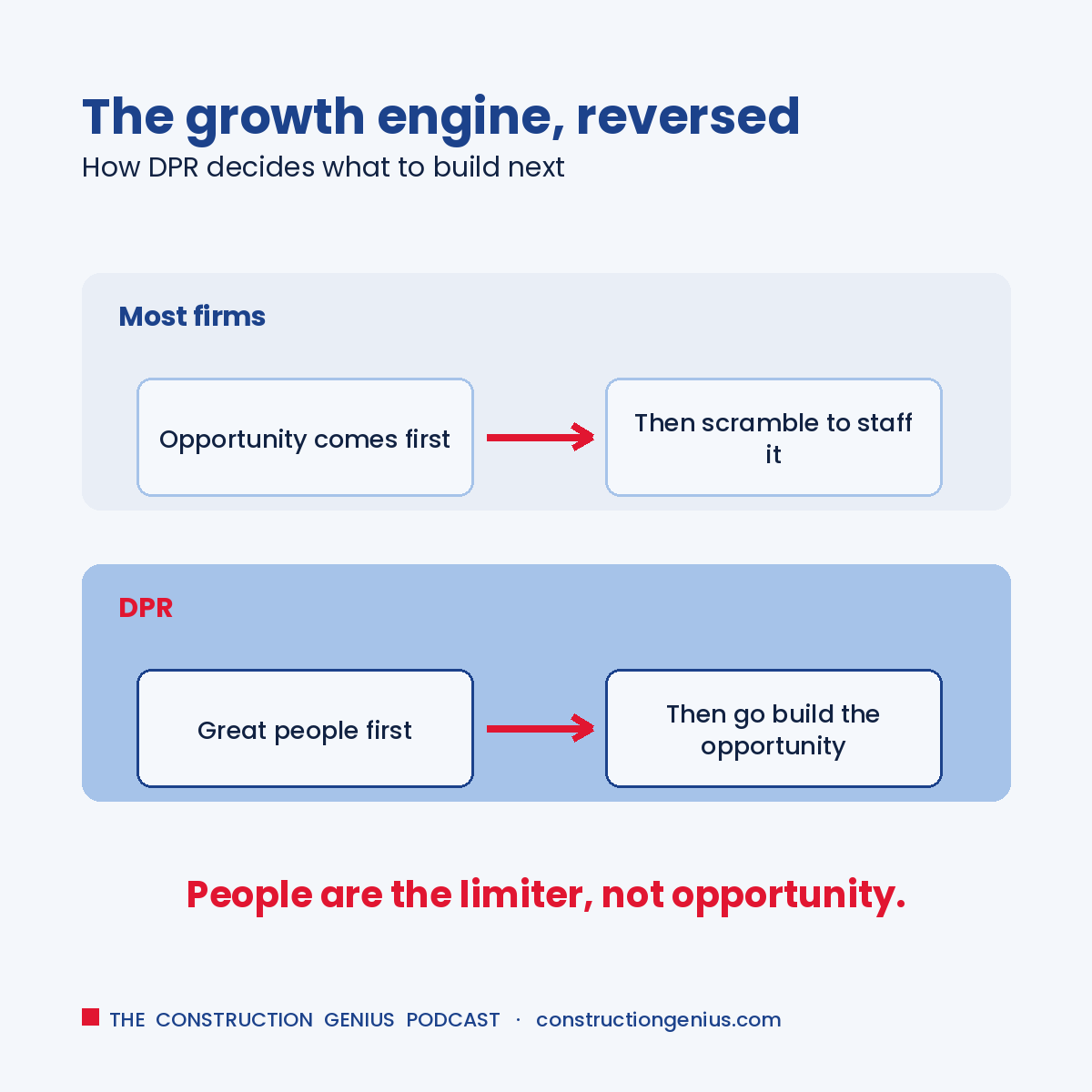
Mark: A lot of companies view it as: you have an opportunity, so you find the people to fill it. DPR is a blend, but even more focused on the reverse — we’ve got great people who want to take advantage of an opportunity, so what can we go do that grows the business?
And too often people think of growing the business strictly as geographic or revenue growth. For us, it’s doing more with less. It’s more vertical integration across the construction life cycle. There’s a constant need for opportunities for people. It’s a yin and a yang, but people are definitely the limiter, without a doubt. Today there are probably more opportunities than there are people. That’s a challenge across the industry, not unique to us.
“Willing To” Beats “Want To”: What Gets People Promoted
Eric: You rose into leadership at a relatively young age. What was it about what you were doing that caused you to rise? A couple of specific things, or just you being you?
Mark: I’d like to think they saw a constant desire to learn and to be great at what I did — but also to do it with others, not instead of others. Back to running your own race: too often we put ourselves in competition against others, when there are so many opportunities. I didn’t set out on a mission to do what I’m doing today. The opportunity came through me being willing to focus on what’s right, not who’s right.
The other thing is the difference between “want to” and “willing to.” The “want to” is more self-satisfying. “Willing” is more company- or teammate-satisfying. I’ve tried to model my career on being willing to do the things that need to be done, whether I want to or not. I think that’s been a differentiator for me, and maybe something they saw early.
Why Top People Stay When Recruiters Call
Eric: One worry always running around in the head of leaders in your position is how many calls their top project manager got from recruiters this week. DPR is known for keeping top people for decades. What made you stay when other opportunities came calling?
Mark: There have been a couple of times I actually considered leaving, and at least answered the phone. It starts with the culture. When you compare DPR to other places, there’s a different philosophy around shared leadership versus a hierarchy of leadership, a different philosophy around doing things in teams versus a single person. There’s a camaraderie — the phrase we use is “one DPR.” When it came down to it, I realized the grass isn’t greener on the other side.
Most people who leave DPR — senior leaders or up-and-comers — leave to go start their own thing. And honestly, we’ve prided ourselves on that. As much as it hurts in the moment, it’s a great thing, because that’s the kind of people we hire. We want them to feel like owners of DPR and be owners of DPR. Ultimately they want to go do what Doug, Peter, and Ron did. Us having a little influence on them to go do something great for the industry is a great thing. It sucks in the moment — I’m not going to lie — but ultimately I’m happy for them.
When Employees Leave to Start Their Own Companies
Eric: I was just interviewing Brad DesJardin, who started his own company with Neil and learned so much from DPR about the importance of values. In construction, a lot of companies say “screw that guy, I hope he fails.” It’s neat that’s not how you think about it.
Mark: It’s more the frustration of losing a friend — somebody you love building great things with. It’s not about “hey, they’re going to start their own thing.” It’s like losing a friend or having someone move away. You have a little grief, but at the end of the day you’re happy for them and you want what’s best for their families.
My take
If one of my best people leaves to start their own company, I’m fine with it. I developed them once, so I can do it again. Neil and Brad are one example of DPR alums who left to start their own gig. They compete with DPR, and DPR isn’t bitter about it. DPR is proud of how it shaped them, and you can see that impact in the way they run their operations.
Passing Company Values From One Generation to the Next
Eric: The founders did a lot of work clarifying their values and vision. One of the hardest things for a company is passing that from generation to generation, and you’re into the second or third generation. What are your plans for making sure DPR achieves its vision and values over the long term?
Mark: Jim Collins has had a big influence on us — the “first who, then what.” We spend a lot of time, sometimes too much, identifying the right people to bring into the company. That’s where it starts. Our four core values are integrity, enjoyment, uniqueness, and ever forward. Some of those, especially integrity and enjoyment, can be ingrained in people, so if we find the right “who,” that helps.
We also talk about it a lot — we don’t just put the words on the wall. A couple of years ago we did what we called a Culture Con. Myself, George, and several leaders hit every office in about 8 to 12 weeks, all craft and admin employees, and had conversations about our culture and the power of connection. Coming out of COVID, we were worried about that — we’d hired about 800 admin and 600 craft during COVID, and onboarding was different. Those all-hands conversations gave people a good glimpse of what our culture means, and gave us a chance to put the onus on employees. One of the biggest reasons culture doesn’t translate from one generation to the next is that it’s too reliant on one or a few individuals. We believe everybody owns it, and we build that from onboarding. That gives us confidence about where we’re going.
Why a Company Built Around One Person Is a Company at Risk
Eric: You started with three partners, which builds in from the start that it’s not just one guy. That’s one of the failings of a lot of construction companies — it’s built around one guy, and then the one guy goes away and the company goes away.
Mark: There’s a great story there. Probably 10 or 12 years ago, Doug was awarded CEO of the Year in the Bay Area. He refused to accept it without Ron and Peter there with him. He said it was an award for the three of them, not for a single individual. It shows you the philosophy and mindset that permeates the company.
How to Give Someone a Stretch Assignment Without Setting Them Up to Fail
Eric: As you build people through the organization — one of the failings in career development is how to give someone a stretch opportunity without setting them up to fail. How do you handle that?
Mark: First, it comes with a lot of conversation about what the opportunity is and what the criteria for success are. Too often people apply their own definition of success or failure instead of aligning on it. And sometimes we’re just asking people to learn — it’s less about delivering more money or a project, and more about growing a muscle they didn’t have before. The scorecard is sometimes not clear. Having a clear scorecard that isn’t solely about wins and losses is a big piece.
The second is enough connectivity with their coach — knowing “when do I pull the rip cord,” who can I use as a sounding board. Our shared leadership philosophy is “better together.” We don’t build projects by ourselves and we don’t lead initiatives by ourselves. You may ultimately be accountable, but we do things in teams. Giving people the comfort that they’re not alone is another piece that’s helped.
My take
A stretch assignment goes bad when nobody said out loud what success looks like. You give a young PM a job bigger than anything they’ve run, you stay out of it so they can grow, and when it goes sideways you decide they weren’t ready. Half the time you set them up for that. Before it starts, tell them what you’re watching for and what counts as a win. Sometimes the win is bringing the job in on time. Other times it’s learning to run a job that size at all, and losing a little money along the way is fine. Then give them one person they can call when they’re stuck, so they’re not guessing alone.
Integrity in Construction: The Confidence to Walk Away
Eric: One of your core values is integrity. A complaint I hear is “we have integrity, but the owner doesn’t,” or “our subs don’t,” and the pain of a project magnifies. How do you filter who you do business with so your values match theirs?
Mark: It starts with operating with integrity internally first. About 12 years ago we started an internal training called Character Matters. Sam Reed, a consultant and former DPR employee who left to start his own thing, helped us build it. We embedded a ton of examples around the tough questions: Where’s the line of integrity? What’s a breach? What’s too much, what’s not enough? If a subcontractor does X, or an owner does Y, how do you handle it? Talking about it and giving people the examples is fundamental.
The other piece is empowerment. A lot of companies — and we have at times too — feel like if we don’t win this one project, the company or the business unit is going to fail. Having enough confidence to know that we don’t do a project with an owner who isn’t operating with integrity — because if they’re not, our team is going to have a miserable experience and our culture doesn’t support it. That confidence to just walk away is a learned muscle. It’s especially tough for folks who come mid-career from a company that operated differently, because they had a different scorecard. So you have to constantly talk about it.
My take:
Being willing to walk away matters more than walking away. The willingness is what gives you power at every step of the negotiation. A client can feel it when you don’t need the job, and it changes how they treat you. You can’t fake this. If your backlog is empty and payroll is due, you’ll take work from someone you already know is trouble, and you’ll spend the next year paying for it. An owner who cuts corners in the interview will cut corners on your money.
Developing the Next Generation of Construction Leaders
Eric: That confidence comes from both the quality of your work and the relationships you build — if you do good work and you’re good people, opportunities come in the door and you can walk away from the ones that don’t fit. You’re 35 years in business, and construction is facing a generational handoff. How do you think about preparing the next wave of leaders?
Mark: Most people would give you an AI answer here. Future leaders do have to evolve with technology, but I’m not going to focus on that. Preparing future leaders at DPR begins with the same things it did when I started: communicating, creating opportunities, supporting and coaching people through them, and allowing them to fail — but fail right. Fail in a way that they grow.
One of the worst experiences I’ve seen is when somebody had a challenge and didn’t handle it as well as they could have, and the coach didn’t support them, didn’t understand why they failed, and didn’t even look at themselves to understand what they should have done differently. Then the person leaves, or puts themselves in purgatory for a while. That’s all part of growth.
The other piece is that we talk a lot about growing enterprise leaders, because we’re more than a construction company today — more than we’ve ever been. Future leaders need the skill sets to work across design, prefabrication, logistics, the trades, VDC, self-perform, and financials. Complete leaders. And some things we don’t even know yet — technologies or offsite construction methods. We’re building leaders with adaptability for the future.
Why Developing Construction Leaders Takes Patience
Eric: To become that well-rounded leader takes a while — it won’t happen overnight. There has to be an “impatient patience”: impatient because there are lots of opportunities, but patient because you have to grow as a person, technically, and in relating to people.
Mark: Yes. And some folks today actually want to be told the best practice rather than create it on their own, while others want to create it themselves. You have to have a mindset that allows both. You need programs that train people and show them how it’s done, and you need opportunities for the people who want to take that on themselves. The worst thing you can do is put everybody in the same box and stifle their learning.
Forget Legacy: Turning the Impossible Into Possible
Eric: As you reflect on your position, what do you want your legacy to be — the impact you’ve had on people?
Mark: It’s an interesting question, but I don’t think about a legacy at all. I think about creating opportunities for people, the ones I had and the ones I didn’t. A few years ago we went through a leadership development exercise around everyone’s personal purpose. For me, it’s helping others turn the perceived impossible into possible. I really enjoy hearing someone say something can’t work, and helping them see ways to push past those perceived limits and challenge their own status quo. I don’t view that as a legacy — I view it as growing great people doing great things. Hopefully there are folks who have a little more of that than they did before we interacted.
Would He Want His Kids to Join the Family Industry?
Eric: You have three kids. Are you the dad who wants them to follow you into the business, or is it whatever they want to do?
Mark: It’s probably mixed. There are days when they see how hard I work and how much I travel, and think, “that wouldn’t be all that fun.” But what’s most inspiring for me — and for my wife — is that they see the company I work for and the things it cares about, the things that are different from a lot of industries. There are almost 12 or 13,000 people at DPR, and my kids see how many of them love this place, for all different reasons. Those are the days I’d love for my kids to join DPR, if that’s what they want. But I’m definitely not “you’ve got to be in construction, you’ve got to be at DPR.” That’s up to them.
Why He’d Tell His Kids to Work Somewhere Else First
Eric: If they did want to join DPR, would you advise them to work somewhere else first, or just say “come on in”?
Mark: I’d probably advise them to work somewhere else first. I appreciate DPR in a whole different light because I started here. People we hire mid- or senior-career sometimes get surprised when someone at DPR is frustrated about something — and they’ll say, “y’all have no idea.” You think of bureaucracy or micromanaging, and people who come from other firms most often say, “you have no idea how good you have it.” Seeing some of that from other places first would be a good experience — for my kids and for anyone.
How to Build a Construction Culture Where People Stay for Decades
Eric: If a listener wants to build a culture where people stay and grow for decades like they have at DPR, what are a couple of things they should focus on to get on that path?
Mark: One, whatever the backbone of the culture is — do what you say. Create an environment where people are empowered and know they can use their voice. There aren’t many people who like to be told what to do. If you want to build a company on a foundation of attracting and retaining great people, you’ve got to let people bring their value in. I remember Doug and others saying early on, “we’d be stupid to hire somebody from another firm with 10 or 20 years of experience and not let them help make us great.”
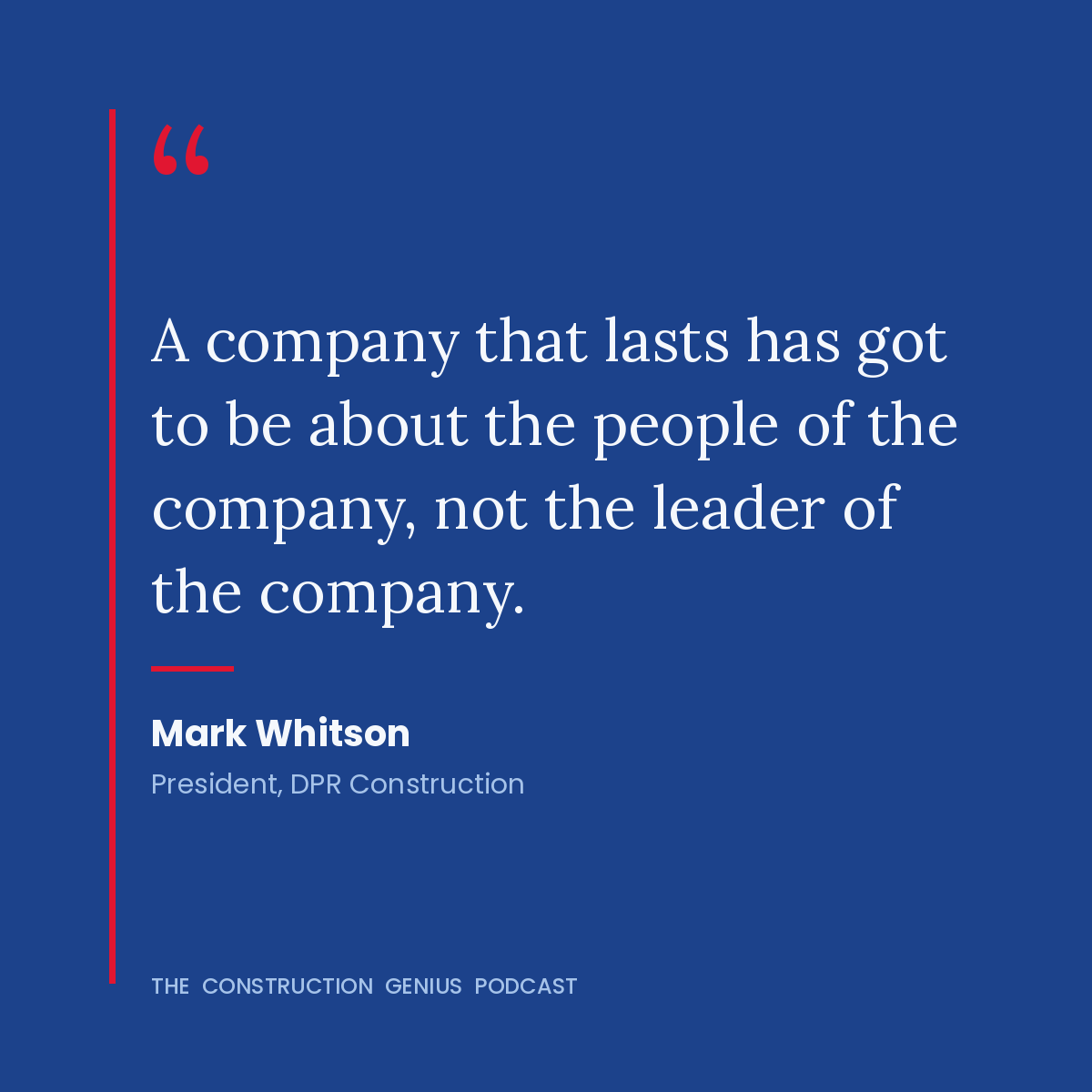
The last piece: if you’re trying to build a company that lasts, recognize that it’s way bigger than you as a leader or as an individual. A company that lasts has got to be about the people of the company, not the leader of the company. Build on those backbones and you’re off to a good start.
The real test of your culture is whether it holds up when you’re not there. Plenty of construction companies run great as long as the owner is on site every day. That looks like a strong culture right up until he retires, and then it falls apart. If you want the thing to last, your people have to carry it without you in the room. That means letting them make real decisions, and observing how well their actions and outcomes align with the culture that you want to last after you’re gone.
One Last Thing: A Golf Course Worth the Trip
Eric: Last question. I know you like golf. What’s the one course you’d recommend everyone hit up?
MarkThere’s one south of Raleigh, North Carolina, called Tobacco Road. For a golfer at my level it’s not easy, but it’s an amazingly beautiful course — super challenging and fun. People would get a kick out of experiencing it, down toward Pinehurst, south of Raleigh.
Build the Kind of Company People Don’t Leave
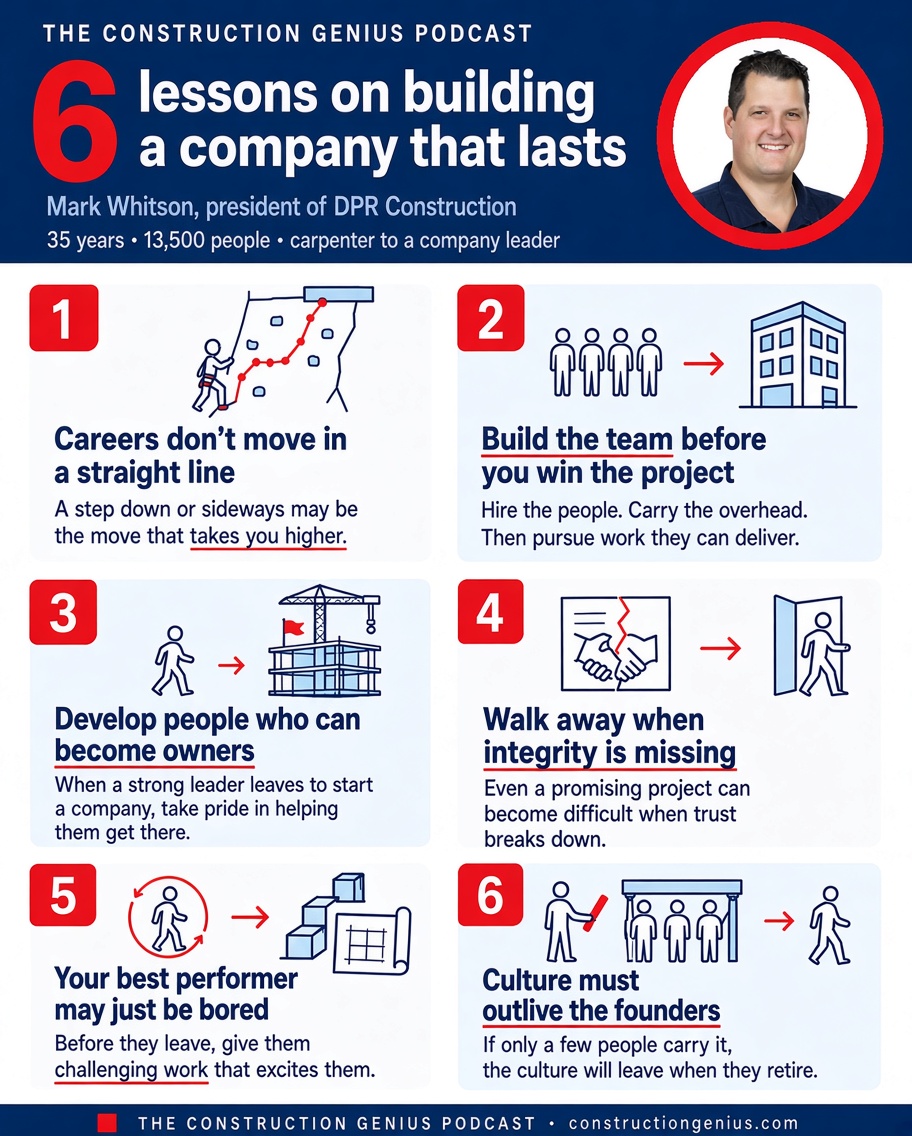
Mark’s throughline is simple. A company that lasts is about the people, not the leader. Everything else he talked about grows out of that: careers that move like a rock wall, stretch assignments with a clear scorecard, the confidence to walk away from bad work, and a culture that everyone owns instead of one founder carrying it.
If you’re trying to build that kind of company, that’s the work I do. I coach construction leaders and their teams on keeping good people and handing off a culture that outlasts the founders.
If any of this hit home, book a call and we’ll see whether I can help. The first one is ten minutes: 10minutes.youcanbook.me/ We’ll explore if and how I can help your leaders, and if I’m not the right fit, I’ll try and point you in the right direction.