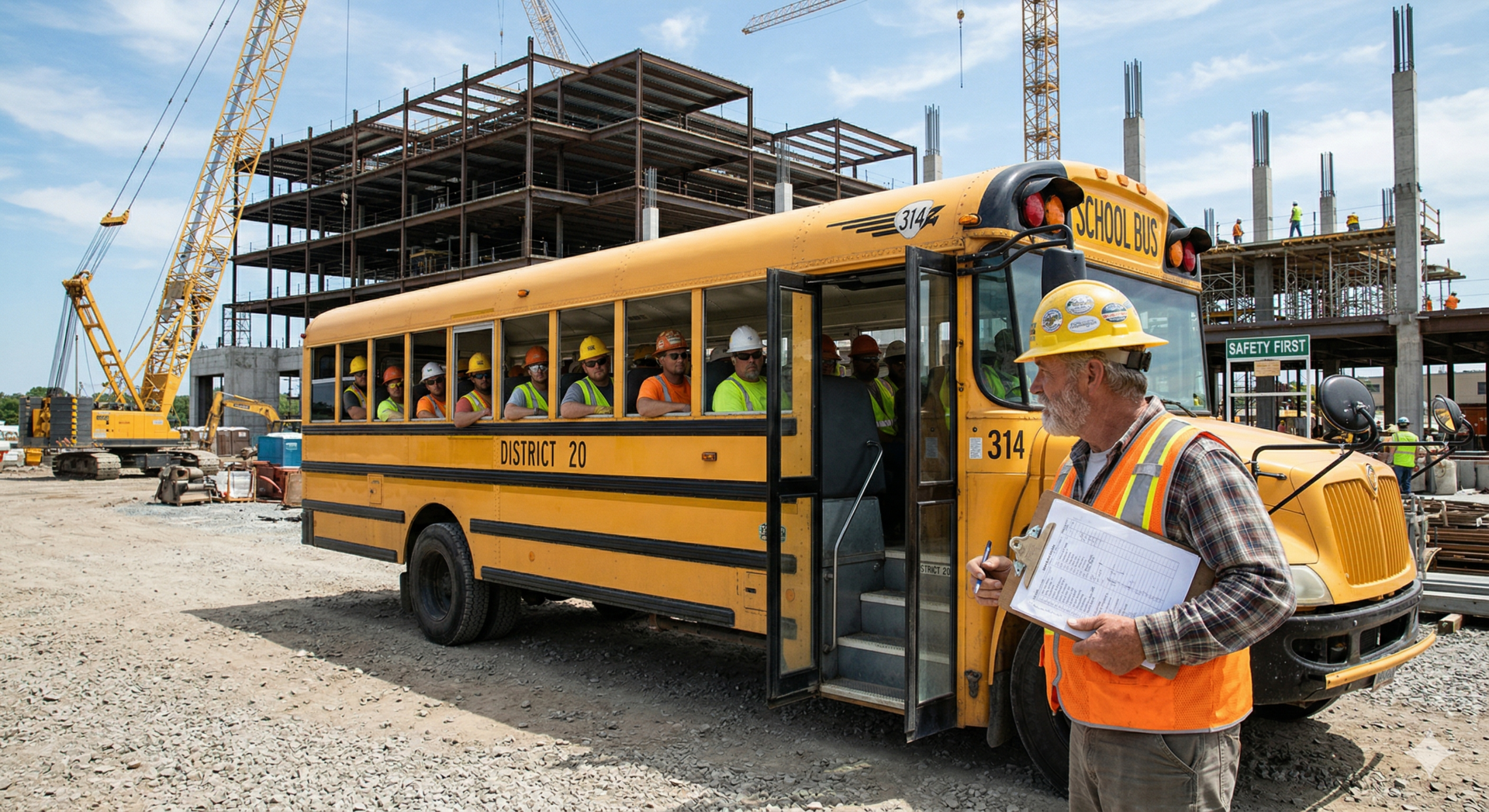
You know what high performance looks like on the surface. The website photos. The company page. Everyone smiling, hard hats on, thumbs up.
And then you get underneath the surface.
People aren’t pulling in the same direction. Communication is broken. Someone on your team has been in the wrong seat for two years, and you’ve been avoiding the conversation.
I’ve worked with construction companies for over two decades. I’ve seen this pattern hundreds of times. So here’s a framework for fixing it.
There are three things you need to understand about building a high-performing construction team. The commitment to never settle. The mindset of high performers. And the action of high performers.
What Does High Performance Actually Mean?
High performance is concentrating on the few tasks that, if done with excellence, will really make a difference in the results of your job and in the performance of the company.
Read that again. Two words should jump out at you. “Few” and “concentrating.”
Not fifty tasks. Not the twenty-seven things on your to-do list today. The few tasks. The ones only you can do. The ones that actually move the needle.
And then you need space to concentrate on them. If you want excellence, you must create space for concentration. Your people need that same space.
Why Trust Is the Foundation of Every Strong Construction Team
Before you can build a high-performing team, you have to build trust. Patrick Lencioni lays this out in The Five Dysfunctions of a Team. The pyramid starts at the bottom with absence of trust. Then fear of conflict. Then lack of commitment. Then avoidance of accountability. And at the top, inattention to results.
Every dysfunction feeds the next one. If your team can’t trust each other, they won’t have honest conflict. If they can’t have honest conflict, they won’t commit to decisions. If they won’t commit, no one holds anyone accountable. And if no one’s accountable, results suffer.
Trust is the whole ballgame. No quality or characteristic is more important.
So how do you build it? One exercise I recommend is the Personal Histories Exercise. Get your team together over lunch. Have everyone answer five questions. Where did you grow up? How many siblings do you have, and where do you fall in the sibling order? Interesting childhood hobbies? Most difficult or unique challenge of your childhood? And your first job?
That’s it. No trust falls. No ropes courses.
Here’s an example of why this works. One company did this exercise, and they got to the CFO. Everyone in the company thought this guy was notoriously cheap. It caused real resentment. When he shared his personal history, it turned out he was raised in poverty.
Does that justify being cheap as a CFO? No. But it gives you perspective. And perspective is what trust is built on.
Trust comes from people sharing their weaknesses, their mistakes, their shortcomings. It takes time to build. And it must be maintained over time.
The Commitment to Never Settle on Your Construction Team
Your number one job as a leader of a team? Never settle.
Never settle in the development of your people. Never settle in who fills what seat. Never settle in your standards.
Bill Walsh coached the San Francisco 49ers in the 1980s. Three things defined how he built those championship teams. He individualized his approach to each player. He was as precise as possible in his coaching. And he was patient, but demanding.
Think about your own leadership for a second. Which of those three do you need to work on?
Most leaders struggle with precision. There are things you do intuitively that contribute to your high performance. You don’t even think about them. So when you delegate a task to someone, you leave those things out of the instructions. Then you’re disappointed when the person doesn’t perform. The problem isn’t them. The problem is you weren’t precise enough.
One quick tip. Pick up your phone. Dictate the task into ChatGPT. Be as detailed as possible. Then ask it to turn that into an SOP. Tweak it. Hand that to your person. Now you’re being precise.
How to Know If You Have the Right Person in the Right Seat
You should be asking this question about every role in your organization. Do I have the right person on the bus, in the right seat?
Right person means they’re a cultural fit. Right seat means they’re a technical fit for the role they’re filling right now.
For every role, you need to define three things. Why does the role exist? What must the person get done? And what behaviors are non-negotiable?
Take a foreman role as an example. The core purpose might be to ensure efficient project execution by managing on-site operations, leading the crew, upholding safety, and delivering timely, budget-compliant, high-quality results. The outcomes might be timely project completion, quality control, safety management, and effective crew leadership.
And then the behaviors. You need 3 to 8 non-negotiable character behaviors that describe your culture. Dependable. Humble. Honorable. You get to define these. But you better be specific about what they look like in practice.
The GWC Framework for Evaluating Your Team
There’s a framework from Gino Wickman’s book Traction that I use constantly in my coaching. It’s called GWC. Get it. Want it. Capacity to do it.
Pick one of your direct reports. Ask three questions, and force yourself to answer yes or no. No maybes. No stories. No qualifiers.
Do they Get it? Do they truly understand their role, the systems, the culture, the pace, and how everything fits together?
Do they Want it? Do they genuinely want the job, the day-to-day work, and the responsibility? Not the title. Not the status. The actual work.
Do they have the Capacity to do it? Do they have the time, the skills, the emotional intelligence, and the mental and physical horsepower?
If any answer is no, that person is in the wrong seat today.
Here’s a test I give my coaching clients. I call it the 5 AM Text Test. You get a text from the person who’s giving you the most headaches. It’s 5 AM. They say, “I found a position with another company.” How do you respond? Do you say, “Please don’t go, let’s talk”? Or do you say, “See you later”?
If you’d say see you later, then why are they still in the company?
You’ve got three options. Train them. Reposition them. Or remove them. You can’t just sit there and keep complaining.
GWC doesn’t lie. If you don’t get a yes on all three, you can’t delegate. You will stay stuck. They will stay frustrated. The company will feel it.
The Mindset That Drives High Performance in Construction
There are five areas that influence achieving high performance. I call them TDAAT. Technique. Discipline. Attitude. Association. And Time.
Consider the example of Mary Meagher. She was 13 years old when she decided to break the world record in the 200-meter butterfly. I was not setting goals like that when I was 13.
She didn’t start swimming more. She made two changes. She committed to showing up on time to practice. And she made one small tweak to her technique. Instead of touching the wall with one hand at the end of each lap, she touched with two.
That’s it. Discipline and technique.
In 1979, at age 14, she broke the world record. In 1984, she won three gold medals at the Olympics.
Mary said, “People don’t know how ordinary success is.”
What change could you or someone on your team make in just one of those five areas? Maybe it’s a technique change. Maybe it’s a discipline change. Maybe they need to hang out with different people. That’s the association piece.
Pick one person who needs to improve. Pick one area. Help them make that change in the next 90 days.
The 90-Day High Performance Dashboard: A Practical Tool for Construction Leaders
High performance is about task goals. Task goals confine your thoughts. They direct your focus. They leave no room for distractions.
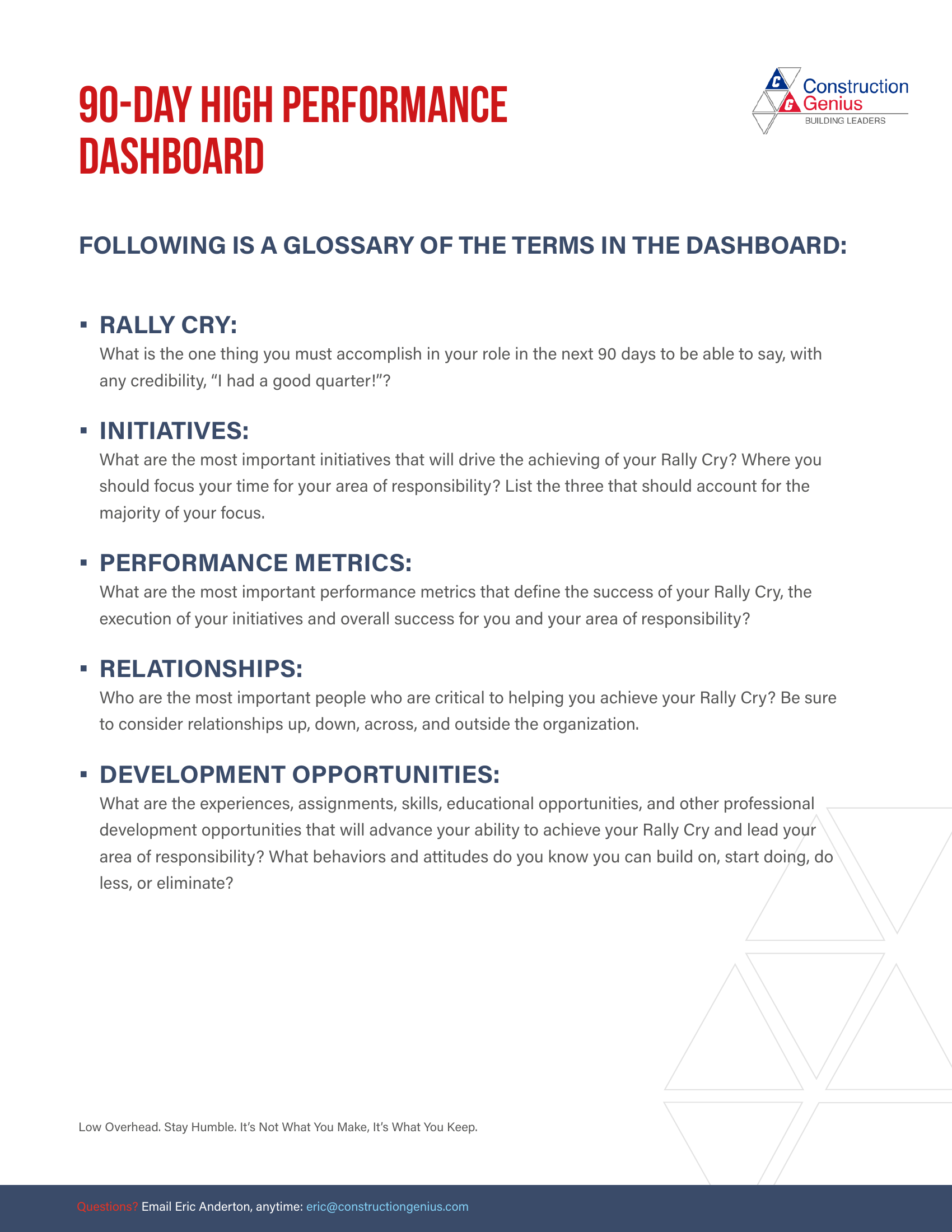
The tool I use for this is the 90-Day High Performance Dashboard. It has five areas.
Your Rally Cry. What is the one thing you must accomplish in the next 90 days to say with any credibility, “I had a good quarter”?
Your Initiatives. What are the most important initiatives that will drive the achieving of that rally cry?
Your Performance Metrics. What numbers define whether you’re winning or losing?
Your Key Relationships. Who are the most important people critical to helping you achieve your rally cry? Think up, down, across, and outside the organization.
Your Development Opportunities. What skills, experiences, or behaviors can you build on, start doing, do less of, or eliminate?
Here’s how you use it. Show the tool to your direct reports. Have them fill it out for themselves. Then sit down with them quarterly to review it together. Come to an agreement on what they’ll focus on. And check in weekly on how they’re executing.
Why do they fill it out themselves? Because people need to weigh in before they buy in. Ownership and accountability start there.
If you get into this rhythm of setting 90-day goals and holding people accountable weekly, you will build a high-performing team.
Download the 90-Day High Performance Dashboard
Use this with every person who reports to you. Print it. Hand it to them. Have them fill it out before your next quarterly sit-down. It’s one page. Just the five areas that matter.
What High Performers Choose Every Day
High performance is a series of choices. Every day.
High performers choose to get something out of every situation rather than complain. They choose to hustle rather than coast. They choose to be prepared rather than just show up. They choose to be consistent rather than occasional.
They choose to be early rather than just on time. They choose to learn rather than explain or excuse. They choose to do more rather than just enough. They choose to be mentally tough rather than mentally lazy.
They concentrate on what to do rather than worry about what might happen. They accept adversity as part of the game. They share with others rather than hoard. They think and act positively.
Don’t overcomplicate this. Get crystal clear on what needs to be done in each role. Focus your people on the few things that matter. Coach them. Hold them accountable. Never settle.
That’s the job.