

The Construction Genius Podcast · Episode 374
Camilo Garcia and Mike Humphrey co-lead DPR Construction’s Northeast region. Mike has been with DPR for 33 years and Camilo for 23, and together they run the region’s offices and teams. In this conversation, they trace the cycles DPR has been through, from its early boom to the 2009 crash to today’s surge, and the disciplines that carried the company through.
Listen to the full conversation on episode 374 of the Construction Genius podcast. And if you’re following the series, here’s my earlier conversation with DPR president Mark Whitson on building a company that lasts.

The Culture That Carried DPR Through Every Cycle
Eric: Today I want to look at the different cycles DPR has been through since its founding. You’ve both lived through different eras. Mike, across your 30-plus years, what’s the cultural core that has carried the company through two and a half cycles of boom and bust?
Mike: The cultural fundamental has always been our approach toward people. It’s a strong respect for the individual, trust, giving people chances, building relationships. That people-friendly core is what helped us succeed in the early years and take on so much work. People wanted to work with us, both because we wanted to be excellent builders and because we’re collaborative and innovative, and we treat each project and each customer individually.
Eric: Camilo, what’s your perspective on that?
Camilo: Very similar, Eric. It starts with people. What has carried us through the years is that, first, we hire the best people, and we’re really purposeful about it. When we bring somebody on board, we’re bringing them on for a career, not for a project. We’re hiring them for their technical abilities and their expertise, not because of their resume.
The common thread is that we’ve been able to get great people, and we reinforce the culture by making sure it’s much more than what’s written on the wall. It’s the behaviors we take when nobody’s watching. It’s how our teams act in the field when they’re making calls, how they treat their partners and subcontractors. It’s a culture driven by behaviors and actions rather than by authority and “you must do.”
How DPR Hires for Culture, Not Resumes
Eric: In the hiring process, what does DPR do that other companies don’t, to identify whether someone is a cultural fit?
Mike: A couple of things. One, we’ve been accused of having a gauntlet of an interview process. Part of the reason is that we want a diverse group of people to meet the candidate. It’s not just one person, and it’s not Mike Humphrey looking for more Mike Humphreys. It’s a number of us with different experiences and backgrounds exploring whether this is someone we can see ourselves working with, and maybe working for.
The questions are just different. Instead of “what are your strengths and weaknesses” or “tell me about your last role,” we ask things like, “Can you give me an example of a time you had to make a decision based on your values, and maybe a hard one? How did you come to that decision?” A lot of it is checks of integrity. Are you someone who can be trusted to make decisions on behalf of a customer?
Camilo: What I’d add, especially with mid-career hires, is that the question that gets a real reaction is, “What are you most passionate about? Where’s your passion?” The best way to set people up to succeed is to put them where they’ll show up passionate about the work.
There are really two groups: mid-career hires and entry-level hires. With mid-career people who already have experience elsewhere, the way we support them feels a little different. It’s “How can we help? What do you need? Here are the resources we have for you.” With a brand-new college grad, someone new to the industry, it’s more about how we teach and show them, and making sure they know they’re going to make mistakes and we’ll all learn.
I remember when I was a project engineer and I made a mistake on the first project I worked on. It was brutal, to this day. But it was how the project manager and the project executive took me, showed me the mistake, and engaged me on how to solve it. So what we bring forward is people instead of blame. How can we teach them, how can they learn? That’s what makes people feel valued here.
My take
A resume tells you what someone has built. It can’t tell you how they’ll handle a conflict, or the hard calls about who to hire and who to let go. That’s what DPR’s interview is built to find. A whole panel meets every candidate, so no one leader hires a copy of himself. The questions have no right answer, because they’re watching how you think, and the fastest way to fail is to fire back something rehearsed. They’re also hiring you for a twenty-year career, which is a different bet than staffing a single job.
The Interview Tell That Reveals a Fake Answer
Eric: When you ask a question like “give me an example of a decision you made based on your values,” how do you know when someone’s blowing smoke?
Mike: Great question. I’m not an expert in reading body language or tone of voice, but there are tells. When you’ve interviewed enough people, you can tell who’s coming across as super polished and who actually stopped and thought about it. The number one indicator might be whether they paused before answering. Anybody who answers a question like that without taking a deep breath is blowing smoke. It’s a question that requires some thought.
Eric: I’d imagine that’s a challenging question for a younger person coming out of college, who doesn’t have a diverse business background to draw on.
Mike: That’s very true, and there are times you let people off the hook. You don’t want them to be uncomfortable. The questions change based on age, tenure, and experience. The trickiest part is that we’ve now gotten to hiring at pretty senior levels, close to executive. The driver is that we grew extremely organically, so we ended up with a lot of people like me, here 33 years, and this is all I know. We recognized we needed more differences of opinion. So on a values-based decision, there’s no right answer to a lot of the questions. It’s more about how you think, and how you share what you’re thinking.
Camilo: What I’d add is the idea of freedom within the framework. We empower people, and that’s the best thing we can do, because you’re going to learn, make mistakes, and get exposed to things you didn’t expect. But because we’re a value-driven organization, we also have to be clear about where you stop, where the sinking hole is that could sink the ship. Those become the trigger points that tell us when we need to support someone differently.
Bringing in New Ideas Without Breaking the Culture
Eric: One friction point with a mid-career hire is that they’ve been doing something a particular way for 10 or 20 years, and you do some things differently. How do you negotiate incorporating new ways of doing things while maintaining the DPR way?
Camilo: We wrestle with this every day, and I don’t think we have the perfect solution. What we do bring is that we embrace it. We know somebody may bring forward an idea that’s better than the way we’re doing it. Instead of dumping a policy-and-procedure manual on them, we say, “Here are the best practices, here’s what we think we should do, but if you’re bringing something better or different, we embrace that.” Our competitors have developed great people and delivered great projects too, so something is working there as well. The point is how we take some of those things and build from them while keeping our freedom within the framework.
Mike: There’s a book, How the Mighty Fall, and one characteristic of companies that fail is hubris. So we work hard not to have the arrogance that everything we do is the best of the best. We’re anxious to learn. We’re a learning organization, and Ever Forward is one of our core values. There’s a balancing act between a habit that stretches our thinking and a habit that could damage our culture. Those are the distinctions.
Stretch Assignments: How DPR Grows People
Eric: Going back to the cultural piece, you used a phrase at the beginning, “give people chances.” What do you mean by that specifically?
Mike: It’s actually a tenet of our development program: what we call stretch assignments. A stretch assignment is meant to get somebody out of their comfort zone, to see what they learn about themselves and whether they can find a new approach. You learn things much more deeply when you feel them, when you have ownership, rather than being told. So it’s an intentional part of development.
That’s when you have to give people chances, because you’re asking them to get out there, take a chance, try something new.
There are always best-practice starting places, “if you don’t know where to start, start here,” but if you find a better way, we’d like to learn from you. It’s done in a non-punitive way. If somebody makes a mistake, we’ll often ask them to get in front of their peer group and talk about it, not to punish them, but so the rest of us can learn. Those are real maturation moments, standing in front of your peers and saying, “I made this mistake, I didn’t see it coming, and here’s what I’ll do differently.” Those things draw us closer.
Why DPR’s Org Chart Is Upside Down
Eric: Let’s stay in the ’90s, Mike. During that first explosive boom, DPR went from zero to two billion in annual revenue. What did discipline look like, in terms of people, financial decisions, risk, and customer selection? I ask because contractors don’t go out of business because they lack work. They go out of business because they take on too much and execute it poorly.
Mike: We stayed disciplined to what Camilo described, respecting the individual. Here’s an analogy. Most organizations paint a pyramid: the CEO and president at the top, executives beneath them, managers beneath them, and the front lines at the very bottom. Our pyramid is literally upside down. The top is the front lines, the people out taking care of customers and trade partners, the people actually making decisions. Everything underneath is support. We had real discipline about making sure the people closest to the project and the problems are the ones solving them, not running things up a flagpole for no good reason. That we stayed true to.
What we did not stay disciplined about was what kind of work we were chasing. We worked with a lot of great customers who valued us because we’re collaborative, innovative, and transparent. But honestly, we weren’t getting the best results. We didn’t have the best safety results that decade, and we definitely didn’t have the best financial returns. We were doing a lot of work but not making a great percentage on it. There was a real lack of discipline there.
One thing that was consistent with who we are today: we were firing customers in that first decade the same way we would today, customers who weren’t a good fit or didn’t value what we bring. A lot of people wanted us to build for them, so we did get to be selective.
My take
The upside-down pyramid isn’t complicated. Either the people closest to the work make the real calls, or they run everything up the flagpole and wait. You already know which one your company is. The only question is whether you’ll do anything about it.
Why DPR Fires Customers
Eric: Did you start out with that “firing customers” mentality? Because that seems like a healthy way to look at your business, especially in a high-risk industry like construction.
Mike: We did not come out of the gate that way. We were hungry, hungry, hungry for work at the very beginning. Everybody played every role in those first couple of years, and it was a ton of fun. It felt like a big playground. We were building for good customers we enjoyed working for, and they liked working for us. But we were doing an auto dealership, part of an amusement park ride, strip malls, and yes, some very technical work. We didn’t have the discipline yet. We were picking by which customers we enjoyed working with, not by what we could build best.
My take
The best contractors I know are willing to fire a customer. It sounds reckless until you’ve lived through the alternative. DPR stopped choosing clients they liked and started choosing work they could build best. When a repeat customer asked them back for the next phase, they said no, because their people had been miserable the first time around. I see the opposite all the time. A contractor takes the job he knows is wrong, the bully client with the schedule nobody can hit, because saying no to revenue feels like weakness. Then that one job eats a year of margin and burns out your best superintendent.
“We Don’t Want to Win a Loser”
Eric: Camilo, I’ll open this up to you. This idea of the right client, right project, right location — how much time do you spend having that conversation as you filter the opportunities coming your way?
Camilo: A lot, Eric. What we want to be for our clients is their trusted advisor. We want them to see us as an extension of their team, someone who understands their business even better than they do. To do that, we have to stay disciplined about the type of work we take, because when we do, we can be more technical and understand it better. Everything ties back to having the best projects. The way we say it is, “We don’t want to win a loser.”
One of our proudest moments came from a difficult project. The customer asked us to come back and do the next phase, and our response was, “Thank you, but no.” Our teams did not enjoy the journey. How a project feels, how it behaves, the relationships internally and externally, that matters to us. We were thankfully at a point where we could say no, and it meant a lot to our teams that we could go back and say, “That was a bad experience, and we want people to feel proud of the work we do.”
The Near-Nuclear Moment That Forced Discipline
Eric: Mike, at the end of your first decade you hit some tremendously challenging times. What happened, and how did it change DPR’s understanding of discipline going forward?
Mike: It was a scary time. In the first 10 years we grew from zero to about $2 billion. Then the market got really volatile, right around 9/11, the dot-com bubble bursting, the Enron scandal. Everything tightened up, including our relationships with our bankers and surety partners. They took a hard look at our results and basically said, “Fantastic, great revenue, but your returns on that revenue aren’t impressing us.”
It put us in a position where we had to make a really tough decision. Either we bring in more equity, which meant letting investors in and losing full control of our company, or we slow down and contract. A very difficult decision that involved people’s livelihoods. Doug, Peter, and Ron took it extremely personally. They felt they had to take responsibility and fix it. It launched us into the next decade, and that’s where the discipline really started. The first 10 years didn’t teach us much discipline. The second 10 years did.
Camilo: My experience with DPR starts in the early 2000s, right at that point, and it’s exactly what Mike is describing. We called it the Decade of Discipline. For us that meant being purposeful about our core markets, prioritizing them, and making sure we did the right type of work. We also started working what we call our red zone, getting clear on our financial returns from a gross-margin perspective.
When we made those choices, competitors would say, “That’s going to be very difficult. You mean you’re not going to do this type of work anymore? How are you going to survive?” On the West Coast we had to do some projects as joint ventures, we had projects we couldn’t do and had to say no to clients, and bonding was harder to obtain. But it made us stronger and laid the foundation to grow.
My take
In any company, change is hard, and change takes time. That’s the real lesson of DPR’s Decade of Discipline. You have to execute today’s project profitably, hire for today’s need, and handle today’s issues. But at the same time, you have to hold a long-term perspective, and understand that making real changes in your organization can take longer than a year or two. Being committed to that long-term process is essential to success in any business.
That’s why hiring matters so much. You want to play long-term games with long-term people, people who match the values and the strategic direction of your organization, so you can commit together to the challenge of building a great company.
Anti-Cyclical Markets: How DPR Survives Every Downturn
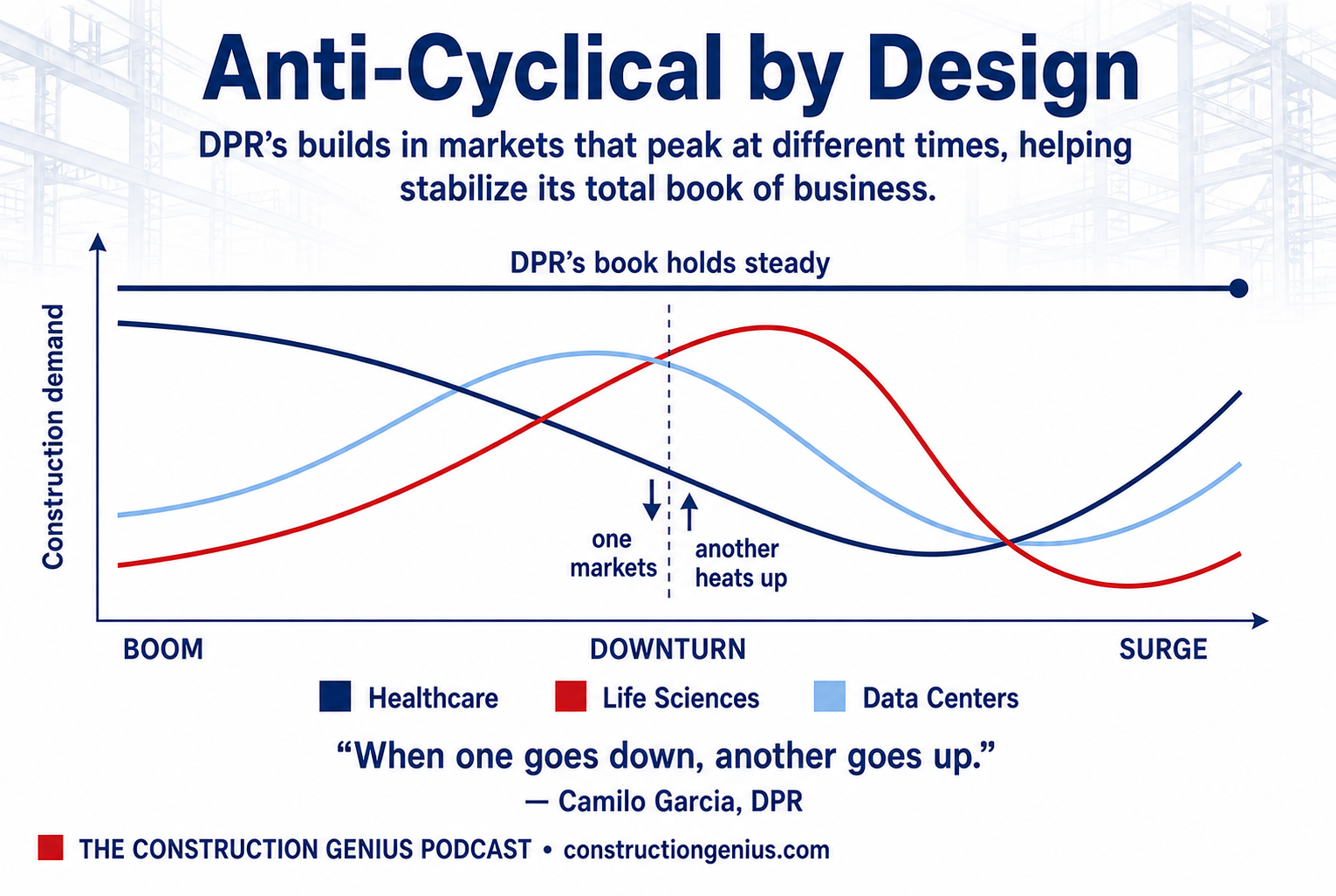
Eric: Camilo, that leads to my next question. Fast forward to 2009 — you’d been with the company five or six years — and the recession hits. How did the decade of discipline set you up for success during that severe downturn?
Camilo: The first thing is that our core markets, as we’ve selected them, are anti-cyclical in nature. When one goes down, another goes up. During that time we were able to double down on core markets, healthcare was booming, life sciences was booming.
The second thing is that we doubled down on mega projects. Some mega projects have a longer runway, both in planning and execution, so balancing our book of business with the stability of those projects was key. It let us ride the wave and keep a place for people to work.
The third thing we learned is that the deals setting up at that time were setting up several years out, not immediately. So we had to be super disciplined about the deals we closed, making sure the lasting impact was positive, not deals made out of desire or need because the economy was tough. We stayed selective, always asking, “When this passes, what kind of backlog and pipeline do we want to have?”
My take
I’ve watched good contractors ride a single market straight up and then straight into the ground. DPR made sure they’d never be that company. They picked technical markets that peak at different times, so when healthcare slows down, life science or data centers are climbing. The catch is you can’t build that when you’re already in a downturn. You build it in the good years, when you’ve got the margin to plant in a market that won’t pay you back for a while. Go look at your backlog. If it’s all one market, it’s time to think seriously about diversification.
Choosing Markets That Peak at Different Times
Eric: Let me ask about that anti-cyclical insight, which I think is important. Did you consciously choose that as part of your strategy, or did you stumble on it and then think, this is great, let’s keep doing it?
Mike: We chose it. We decided our core markets would all be technical markets. There’s a lot of commercial and residential work where low bid wins. And there’s a lot of highly technical work where customers know they need a really intelligent builder, because these are very complicated buildings, life science, healthcare, advanced tech.
We started on the West Coast and were predominantly a West Coast builder through the first decade and a half. OSHPD rules healthcare building out there, and you could see projects coming years in advance because pre-con takes years. So we’d know, “Three years from now there will be two or three big hospitals in this area,” and we’d invest to be positioned for them.
Life science and drug manufacturing moved overseas for a long time, but we stayed with it on the R&D side and the manufacturing side. So when COVID hit and all that manufacturing came back, because the United States needed its drug manufacturing here, we were positioned. We’ve stayed positioned for these waves just by watching the industry.
How Mega Projects Reshaped DPR
Eric: On the mega projects — you grew rapidly in the first decade and it had a negative effect, and taking on a mega project requires the ability to bond it. What drew you into mega projects from an execution perspective? Dig into that a bit. And define it for the audience.
Camilo: The mega projects we tackle are very technical in nature.
Eric: What was the value of a mega project in the second decade versus this decade?
Camilo: When we were doing projects at the beginning of the 2000s, a mega project was about $200 million. Now they’re $2 or $3 billion and growing. And they tend to be more technical, a life sciences project with manufacturing capabilities, a big complex hospital, a data center.
I want to be clear: we don’t want to be the biggest company. We’re not on a mission to chase revenue. What we want is the right sweet spot of volume and book of business so we can have relevance in the marketplace. And we’ve had multiple customers, thankfully, take us to places we weren’t operating before because they want to keep working with us on an account basis, on repeat business. That’s another part of what mega projects do, they take us to new locations to support our customers.
Following Customers: How DPR Expanded Across the Country
Eric: You started in the Bay Area, but you’re all over the country now. Would you say that expansion was more customer-driven than project-driven?
Mike: In the first decade we grew to 18 offices, then leveled out around 13 for a while. Each of those offices came from chasing a customer who said, “You did a great job for us in this city, would you build for us in that one?” They didn’t all stick. We did some really big work in Utah, for example, and that didn’t turn into an office. So it went both ways. We’d build a big job for a customer we already had a good relationship with, grow a team, and then decide: do we send everyone back to other offices, or plant roots? Sometimes we planted roots and the market later dried up, and we had to retract. But it’s very much focused on following customers.
Why Small Projects Are DPR’s Talent Engine
Eric: Is your decision to stay in a market strictly driven by the availability of projects, or do you weigh other things?
Mike: If we’re doing it right, we have this phrase about controlling our own destiny. If we’re going to commit to an office and plant a flag, we do everything we can to make sure the market is there and sustainable. You also have to think about the people you need in each chapter of an office. At the beginning you need people to get out and sell work, meet new customers, develop relationships. After that you need really good executors who can build and keep a strong brand name. People’s energy level shifts with the market, but our commitment to the market doesn’t change.
Camilo: What I’d add is that we want a home base so people can sleep in their own beds, and a book of business that’s sustainable. There’s also the relevance of the name in the marketplace, which again isn’t about being big, it’s about being relevant. People see our signs, our projects, our cranes, and that’s a matter of pride for our people.
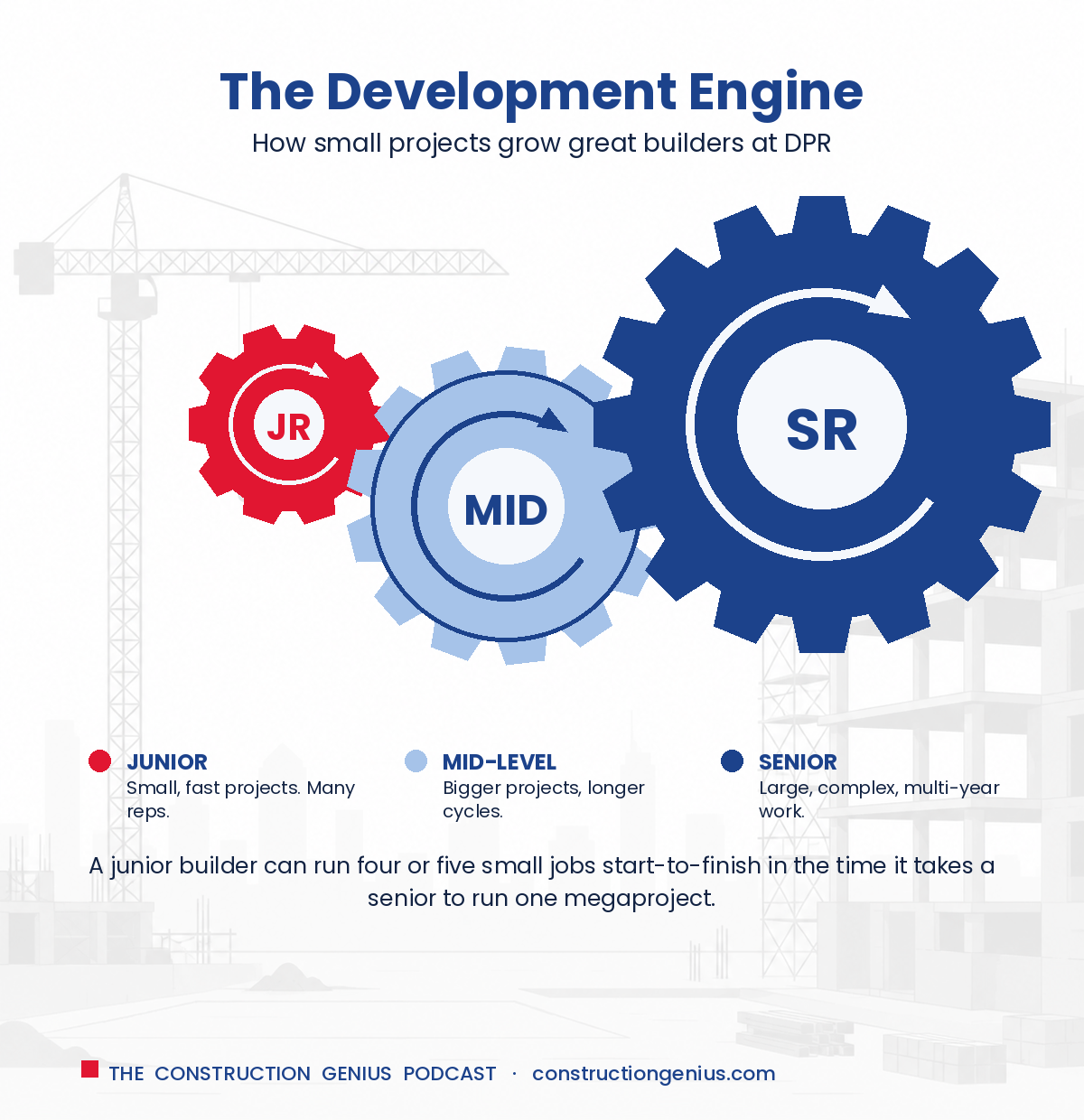
And unlike some competitors, we pay a lot of attention to small projects. We have a special services group solely dedicated to serving customers regardless of project size. That lets us take care of clients’ small work, and it’s given us great stories where a small project grows into much bigger work. It’s a steady book of business, and it develops people, because the churn on small projects is quicker. You start a project, close it, start another, close it, so people get exposed to more of the cycles of construction. It’s an experience-based industry.
My take
A small project with a short life cycle is one of the best ways to develop a young builder, and DPR built a whole group around exactly that. Think about the math. A junior person can run four or five small jobs from start to finish in the time it takes a senior person to run one megaproject. That’s four or five times through the whole cycle, and every time the stakes are low enough that a mistake is relatively small and easy to manage and learn from. You get good at construction by doing it, over and over.
Who Thrives at DPR: Discipline Plus Entrepreneurial Spirit
Eric: During the downturn, what did you learn about the kind of people who thrive at DPR, and who doesn’t?
Mike: It comes back to the core of the culture that sticks. First, we feel extremely lucky that we didn’t suffer nearly as much as our competitor friends. We diversified our workload because we were able to keep some big jobs, but we were still hunkering down. The people who really thrive are those who work within a culture of discipline that supports an entrepreneurial spirit. Another way to say it, as Camilo did earlier, is freedom within a framework. Those people who understand, “I have the power, the ability, the influence to go find the next best work and execute it better. I’ll ask as many questions as I need and find the resources.” Those people with that entrepreneurial side who worked within the culture of discipline are our leaders today.
Camilo:What I’d add is that it’s not only entrepreneurial spirit, it’s also the go-getters. Construction is experience-based. It’s about doing it better, learning, and coordinating with people. Ultimately it’s about attitude. One of the coolest things is the diversity of background of the people who work with us and for us. We really want to hire folks with different backgrounds and expertise, because that’s what gives us different perspectives on how to solve a problem. So the folks who thrive are the ones who come with the right attitude, who are willing to learn, willing to roll up their sleeves, and who are go-getters.
Slow on Fit, Fast on Values
Eric: How long does it take you to figure out you’ve made a bad hire?
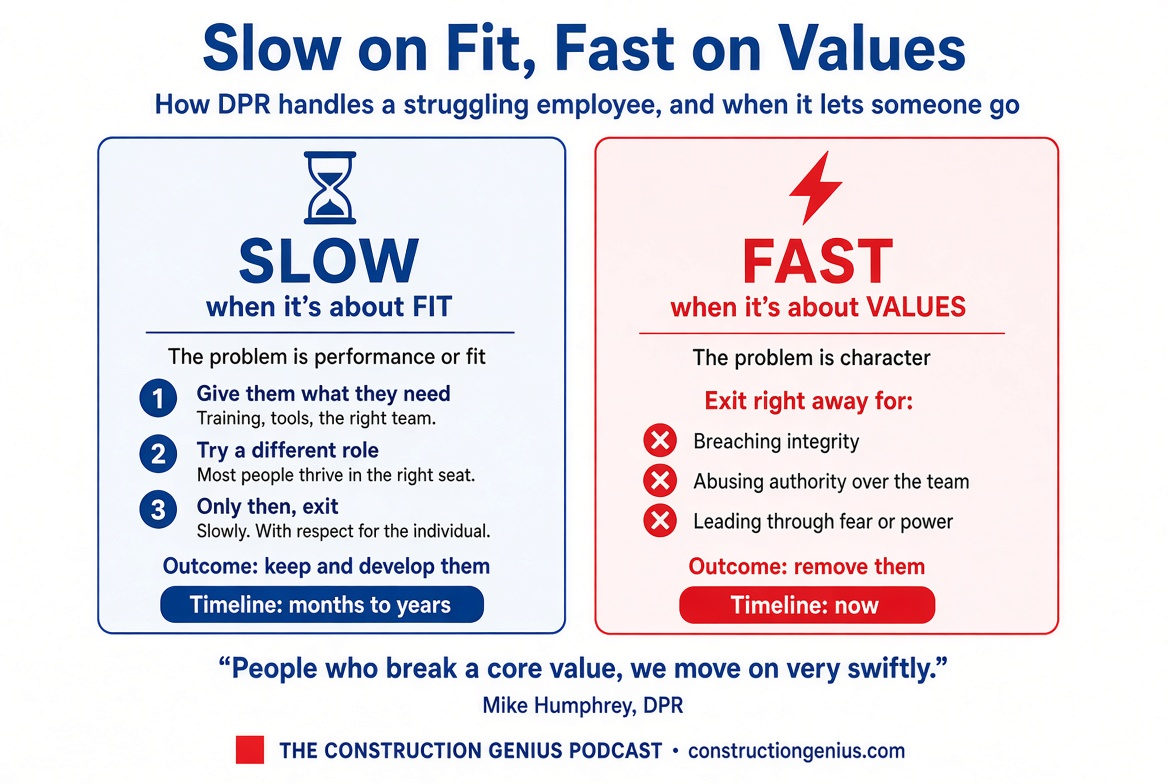
Mike: Great question. Another thing we can be accused of is holding on to a person too long. We might know someone’s a bad hire, but our first instinct is to ask whether we’ve given them everything they need. Did they get the training? Do they have the tools? Do they have the right-size team around them? If all that’s true and it’s still not working, we’re more likely to say, “Maybe this isn’t the right role. Let’s try a different one.” We have tons of stories of people making a role change and absolutely thriving, going from completely unhappy to thriving.
The third move is to remove someone from the company, and that’s a longer process. One of our core beliefs is that if you respect the individual, you can change the world. That respect is what makes it take so long for us to exit a person. Sometimes we waited too long, and sometimes we made bad decisions. But we’d rather err that way than too quickly remove somebody who could become excellent.
Camilo: And as painful as it is, some people just aren’t a fit for how we operate. It’s painful when it’s someone we care about and value, but who can’t thrive under how we empower people, where we don’t have somebody checking the checker. That person may be very capable and technical, but there’s something about the trust we put on people and how we let them shine. Jim Collins has this phrase about throwing turtles, you throw them and see if they swim back. We want to give people chances. But some people want a top-down approach, “Who’s my boss? Who do I report to?” For us it’s not about the title, it’s about the responsibilities and how you do it as a team. Sometimes you have to do something you haven’t done before, or pick up for somebody who needs help. It’s difficult when anyone leaves, but it has to be a good fit both ways.
MikeI’d add that people who make mistakes and get a chance to learn is one thing. People who break a core value, we move on very swiftly. We have a very low tolerance there.
My take
Most of the firing I see is backwards. The technical expert who’s a pain in the neck stays, and the decent person who landed in the wrong seat gets shown the door. DPR flipped that. When someone’s struggling, they go slow. First they ask whether they gave the person the resources and the team to win, and if the answer is yes and it’s still not working, they move them to a different role before anyone mentions the door. When someone crosses a line, like abusing their authority or leading through fear, they move fast to remove them. So they are slow to give up on a person who is struggling, and fast to act when someone breaks a core value. Most companies do the opposite. They are quick to fire someone who just needs a different role, and slow to deal with the person who is hurting the team. Get that order right and you keep your best people.
What Gets You Fired Fast at DPR
Eric: You don’t have to name names, Mike, but give me a specific example of breaking a core value, so people have something concrete.
Mike: There’s certainly a breach of integrity, if somebody is misusing DPR funds or customer funds. Those are swift, and they’re very rare. But there’s also this: we value enjoyment and ever forward, and the environment on a project should be lively. If you’re not having fun at work, you’re probably doing something wrong, or you’ve got a bad apple in the group. And if you hire somebody who likes to manage through fear or through power, those people don’t last very long either.
Camilo: For me, abuse of authority has been one of the biggest points of friction. Because we open up how we approach roles and responsibilities, some people struggle with it. When you’re on a team, it’s not about authority, it’s about how you complement each other and work together. So abuse of authority, along with anything ethical or integrity-related, makes us re-evaluate whether we have the right individual.
Saying No to a Customer Without Losing Them
Eric: Camilo, we’ve talked about disciplined customer relationships. How do you maintain trust when a customer wants to take you into a new area or hands you an opportunity, and you have to say no?
Camilo: A few things come to mind. The first is being genuinely open with customers about when we do and don’t have the right resources to execute successfully. When a client brings us more work, our gut reaction is, “Of course we want to help.” Sometimes that’s the biggest mistake we can make, because we don’t have the right people to execute it. What we’ve found is that when we have the tough conversation up front, “We don’t have the team, but here’s how we can help. Is there something we can do on planning or pre-construction?”, it actually makes the relationship stronger.
Right now the economy and our core markets are very strong, lots of projects, and that’s when it gets tougher, because we want to stay relevant and keep the opportunity, but sometimes we don’t have the people to provide the service. So we double down on relationships, including with customers who don’t have projects today. The fact that they don’t have a project now doesn’t mean they won’t in a few years, and people move between companies all the time. Those relationships matter enormously.
Eric: Mike, anything to add?
Mike: He said it completely. I could pile on, but I’d just be repeating him.
Managing the Data-Center Boom
Eric: Let’s look at today. We’re in an AI-driven data center surge, and you’re doing a lot of work in that space. How is this current boom affecting your people, your culture, and your internal sense of discipline?
Mike: Fantastic question, and you’re right that it makes us a little uneasy to have this much of our work concentrated. We try to balance the core markets Camilo described, and we’re a little out of balance right now. But when we talk about our operating range, a lot of people think in dollar figures. We really think in headcount, in the people resources we need.
Let me make up some numbers to illustrate. A $500 million data center might take 75 or 80 people to build. The same $500 million job as a hospital or a life science manufacturing facility could take double the people. Take it one more level: a hundred small $1 million jobs might need 200 people. We’re balancing all of that. We do balance the markets, but they require very different resources. So it’s a little uncomfortable, but more comfortable than it looks, because the headcount required per dollar of volume is lower in those big data centers. That helps us maintain balance.
Eric: How much time do you spend as a leadership team having these kinds of discussions?
Mike: Quite a bit. They come up regularly. Ultimately we want the company to be successful, and all the incremental parts have to add up. Right now we’ve gotten really big with a lot of work in front of us, so we’ll have to hire to keep up, probably grow our corporate services group to support the new hires, and find more space. There’s a lot that goes with it, which is why we talk about operating ranges, because they affect so much.
Camilo:What I’d add is that because of this boom, we’re also looking at how we can provide our services differently. Of course we’re builders, and we love to build. But the industry is evolving. There’s much more need for prefabrication, for using technology to plan the project, and for automating activities so the project gets done more smoothly and more safely, because we’re minimizing rework, and there’s a direct relationship between rework and safety.
So we’re integrating the services we provide. The way we like to say it is that we want to use our strategies to control our own destiny. That helps us plan the project better and execute it more safely and coordinated. Whether it’s a big project or a small one, if you plan it properly, you can execute it successfully.
How Executives Stop Doing Everyone Else’s Job
Eric: You’re both in executive roles, and one thing leaders struggle with is micromanaging or doing other people’s jobs. How do you discipline yourselves to stay in your own role and avoid getting pulled into needs that aren’t yours?
Mike: This was a hard thing for me to develop. For a long time, the number one reason I’d accept a meeting was that I had time to do it, not because I could add value or get value. I thought I was so important that people needed my time. Removing that hubris, I’ve become a lot more selective. And even more importantly, sometimes I’ll say, “I’m not the right person for that meeting. The project managers are who you really need, reach out to them.” I’ve also had people in my career act as my accountability buddy. I tend to say yes to everything, so I’ll ask someone to say, “Mike, did you mean yes, or did you mean no?” I’ve planted enough of those accountability partners in my life.
Camilo: For me it’s a real struggle. When somebody asks, “Do you have a few minutes?” and we have to say no, it feels wrong, and it feels un-DPR, because we want to help. Two things help me navigate it. First, during the conversation I ask, “Are we here because you’re venting, or because we want to find a solution?” That changes the discussion, because sometimes as people articulate a problem, it comes back down and they realize it’s more manageable than it felt.
Second, asking questions is the biggest tool. If you ask one question and they clearly have a grasp of it, great. If there’s a little more, you ask the next question, and the next, and you dive in, and based on that you can tell whether you can add help or whether they’ve got it. Managing that is difficult, because as we evolve as leaders we transition from doing to influencing, and affecting things through influence is hard and takes time.
The One Discipline That Protected DPR for 30 Years
Eric: We started in the ’90s and we’re up to 2026. Across the boom of the ’90s, the crash of ’09, and today’s surge, what’s the single discipline that has protected DPR the most?
Mike: It’s hard to point to any single discipline. It’s really the cumulative effect of the lessons we’ve learned. We keep coming back to what happens when we get overstretched and the tax that takes on leadership. We have this rubber-band effect, we stretch out, then return. So the discipline is that at the leadership level, despite growth we didn’t intend, we challenge ourselves in really difficult ways.
We’re also good at building consistent metrics for making decisions. We have a red zone with certain questions and dollar figures. We want all our projects in the red zone, and it keeps getting tighter. When we started getting projects over $600 million, over a billion, we created a different set of deal terms that lets us build them, strict criteria that protects the company, protects our people, and makes sure we don’t put our customers in a bad position.
Camilo: What I’d add is that our strongest protection is that we’re still in a relentless pursuit of our purpose. We exist to build great things, great projects, great teams, great people, and ultimately great relationships. As a company our priorities and objectives will change, they have to, with time, with the economy, with our clients. But our core, our DNA, stays true regardless of size, volume, market, or geography. That relentless pursuit of purpose is what keeps us going.
One Piece of Advice for Construction Leaders
Eric: If you were giving a fellow construction executive one piece of advice to thrive in their career, what would it be? Camilo, start with you.
Camilo: Two things come to mind. First, understand the stepping stones that make you better. There’s a push right now, with information flowing so fast, for people to want it now. But there’s real value in making sure you understand something, develop, and get comfortable with it. Some people see that as us not trusting them or slowing them down. It’s the opposite, we’re giving you the tools to be dangerous, in a good way, in how you react when things come at you. Learn the basics and trust that knowledge.
Second, relationships matter. Spend time building your network internally and externally. It’s fascinating how a friend or a client will move and that relationship ends up making a difference for you, the project, and the company. At the beginning we’re concentrated on executing our own work. Sometimes you have to step back and build that muscle of relationships and developing people. That’s what makes the difference in the long run.
Eric: Mike, over to you.
Mike: I’ll steal this one from Doug, Peter, and Ron. As Peter got closer to retirement he told me, “Mike, the older you get, the more you have to protect. You build a business, you want to protect it, so you become a little less risky, a little more safe. And innovation doesn’t live in safety.” If you want to be great, to grow, to transform the industry, you have to never stop learning. At the 25th anniversary, when Doug, Peter, and Ron handed off leadership to our group, they told us: don’t stop being bold, and if you do, surround yourself with people who are curious and innovative. That’s the backup plan to aging, surround yourself with people who are just as curious as you’ve always been.
Build a Company That Survives Its Cycles
Mike and Camilo keep coming back to one word: discipline. They choose the work they can win well and hold that line when a boom tempts them to chase everything, and they grow their people on purpose so the company outlasts any single market.
If you’re trying to build that kind of company, that’s the work I do. I coach construction leaders on staying disciplined through the booms and busts and building teams that stick.
If any of this hit home, book a call and we’ll see whether I can help. The first one is ten minutes: 10minutes.youcanbook.me/ We’ll explore if and how I can help your leaders, and if I’m not the right fit, I’ll try and point you in the right direction.
